On The Pick
A Memoir by Henry Doktorski
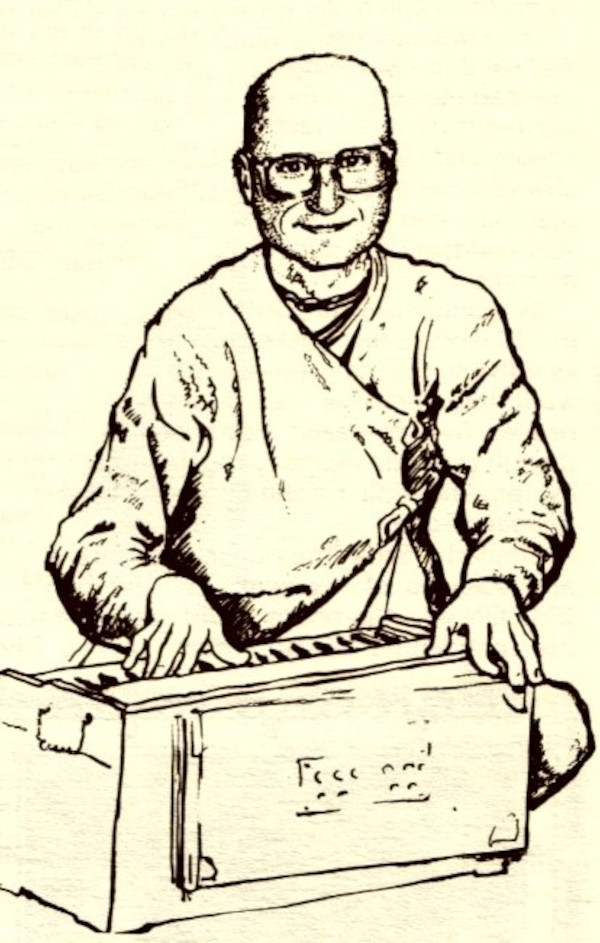
Hrishikesh dasa plays harmonium in the Bahulaban Temple.
Abstract
ON THE PICK: CONFESSIONS OF A WEST VIRGINIA HARE KRISHNA PANHANDLER is a 100,000-word memoir by Henry Doktorski, author of Killing For Krishna, Eleven Naked Emperors, and the 10-volume definitive history Gold, Guns and God: Swami Bhaktipada and the West Virginia Hare Krishnas.
After abandoning a promising potential career as a concert pianist, Doktorski spent fifteen years (1978-1994) at New Vrindaban, West Virginia’s Hare Krishna Palace-Commune, seven of them as a full-time traveling fundraiser—a “picker”—who at his peak raised $150,000 in a single year selling bumper stickers in parking lots across America.
Equal parts spiritual quest, road memoir, and unflinching look at faith-based labor, On The Pick reveals how the Palace of Gold was really built: one dollar at a time, sleeping in vans, eating from dumpsters, and getting arrested at rock concerts.
1. Summary - Main Argument, Themes, and Goals
Main Argument: On The Pick is the first insider memoir of the foot soldiers who funded the most famous Hare Krishna commune in America. New Vrindaban’s rise to national prominence—Palace of Gold dedicated Sept 2, 1979, third-most-popular tourist attraction in West Virginia in 1982, and second-largest employer in Marshall County—was not built by gurus alone, but by hundreds of thousands of hours of grueling, low-status labor by traveling fundraisers called “pickers.”
The author lived it, serving full-time “out on The Pick” from 1979 to 1988, going from a failed rookie who “could hardly get a donation” to a “Maharathi”—a great warrior—known to his Krishna compatriots as “The Professor” and “The Prince of The Pick,” who at his peak got 30,000 people to give him $5 resulting in $150,000 collected for the Krishna commune in a single year. Total contribution on The Pick estimated at $500,000+. One source indicates the community collected $17,000,000 between 1981 and 1986.
Key Themes:
• Conversion and Austerity: A classically trained musician—a piano major who performed with symphony orchestras—trades a career in music for sleeping six hours on the floor, ice-cold baths, Indian-style toilets (holes in the floor), chanting 1,728 Sanskrit mantras daily, a lacto-vegetarian diet, no sex, no intoxicants including marijuana, alcohol, coffee and tea, and the painful “cold turkey” withdrawal from classical music itself.
• The Economy of Faith: The shift from the failed New Vrindaban Spiritual Sky incense business, drug-smuggling funding, and candle factory that burned in winter of 1980, to the professionalization of sankirtan - selling Pope buttons at the 1979 Chicago Pope Pick where 1.2 million gathered and the author collected $1,643 in 16 hours.
• Devotion vs. Deception: Daily reality—dumpster diving behind supermarkets for discarded vegetables to make kitchari: an Indian vegetable porridge, sleeping in a van at Kmart parking lots even in winter, bathing outside with water from a gallon milk jug, running from police and security guards, arrests for trespassing at Nassau Coliseum, Richfield Coliseum, Pittsburgh Civic Arena and dozens of other places, and moral compromises like collecting money allegedly for Viet Nam veterans, Bangladesh hurricane survivors, and passing out American flags on a toothpick with a paper tag: “Made by deaf and dumb people.”
• Loyalty and Cost: Offered a way out—New Vrindaban guru Kirtanananda asking “Would you like to return to the farm? You can teach music at the boy’s school”—and choosing The Pick because “Money is the Honey,” until the author’s body finally breaks down from overwork, inadequate diet, sleep deprivation and exhaustion.
Goals of the Book: This is not another guru scandal expose. This is a preservation of oral history of the pickers as “Warriors for Krishna, rescuing Laksmi (money) from the karmis (non-devotees).” It humanizes the fundraiser as both true believer and exploited laborer, and serves as the personal companion to the author's 10-volume scholarly history Gold, Guns and God.
2. Comparison to Other Books in Similar Genre
This memoir sits between investigative history and leaving-high-control-group memoir. It is distinct because the author was both a true insider for 15+ years (1978-1994) and today is regarded by many as the movement’s definitive historian.
• Monkey on a Stick: Murder, Madness and the Hare Krishnas (Hubner & Gruson, 1988): The classic New Vrindaban book. That book focuses on crime and the downfall of guru Kirtanananda. On The Pick, on the other hand, focuses on the daily economics that made the empire possible - the parking lot, not the courtroom.
• Unfollow: A Memoir of Loving and Leaving the Westboro Baptist Church (Megan Phelps-Roper, 2019) and Uncultured (Daniella Mestyanek Young, 2023): Current bestsellers about growing up fundraising/picketing for a stigmatized faith, then reckoning with it. Doktorski, a Roman Catholic boy from New Jersey to Hindu brahmachari (celibate monk) who refuses to hug a distraught woman because he wants to emulate the Vaishnava saint Haridasa Thakur resisting temptation - is the same test-of-faith structure.
• Going Clear: Scientology, Hollywood, and the Prison of Belief (Lawrence Wright, 2013): For readers interested in how American idealism, charisma, and unpaid labor build new religions. Like Wright, Doktorski shows the business model.
• Academic anchors: Hare Krishna Transformed (E. Burke Rochford, 2007) and Gold, Guns and God, Vols. 1-10: Rochford provides the sociological perspective; Doktorski’s Gold, Guns and God, Vol. 4, “Deviations in the Dhama,” covers abuse. On The Pick is the lived, first-person counterpart - funny, self-deprecating, and granular where the histories are broad.
Market Gap: No one has written a literary memoir solely about sankirtan - the act of collecting itself. This is the first book to document the techniques, psychology, and toll of religious panhandling in 1970s-80s America.
3. Target Audience
Primary:
1. Readers of cult / new religious movement memoirs and American religion - fans of Educated, Going Clear, Holy Hell. 70s/80s counterculture seekers, ex-members and second-generation ISKCON.
2. Existing Gold, Guns and God readers - scholars, journalists, and true-crime readers who have followed the 10-volume history. Built-in platform.
3. Regional / Appalachian history audience - West Virginians who remember New Vrindaban as a point of state pride and controversy, Palace of Gold tourists.
Secondary:
• Students in Religious Studies, Sociology, American Studies courses on NRMs
• Readers interested in immersive, blue-collar America jobs—like Nomadland or Evicted—because picking in mall parking lots is a unique American subculture
• Musicians and artists who left careers for spiritual communities
Part One: Introduction
I served my spiritual master, the ISKCON-approved guru His Divine Grace Kirtanananda Swami Bhaktipada, out on The Pick full-time from October 1979 until September 1985 (with a two-month break from January to March 1980 when I served as Temple President of ISKCON Pittsburgh), and then part full-time and part part-time at least until 1988. The Pick is devotee jargon for fundraising out in shopping center, sports stadium and rock concert arena parking lots, and other places, to collect Laksmi (the Goddess of Fortune commonly known as “money”).
At first I was highly unsuccessful at this trade. Approaching strangers and trying to coax them to give me a dollar or two for charity was incredibly difficult for me. I felt I was a failure. But after a year or two, I discovered the secret to collecting big, and began collecting $1,000 per week. Then $2,000, then $3,000 per week. One year (I think 1984) I got 30,000 people to give me a $5.00 donation. I raised $150,000 for New Vrindaban that year. My total contribution towards the New Vrindaban coffer could have been $500,000. Perhaps more.
I was known as a maharathi, a Sanskrit word for a great warrior. My picking partner dubbed me “The Professor,” and a few years later, Devamrita Swami, the New Vrindaban temple president and sankirtan leader, started calling me “The Prince of The Pick.”
We pickers were respected as warriors for Krishna, rescuing Laksmi from the evil (or at least ignorant) karmis (non-devotees) to reunite with her Lord, Master and Husband, Vishnu, where she belongs. I mostly enjoyed my service. It was exciting at times, often austere, sometimes painful, but it had its own pleasures and perks, which I will attempt to describe in this essay.
The New Vrindaban West Virginia Hare Krishna commune.
In the mid-1980s, the Hare Krishna people were a prominent source of pride (and chagrin) for many West Virginia residents. Prabhupada’s Palace of Gold, an ornate memorial shrine constructed to honor His Divine Grace A. C. Bhaktivedanta Swami Prabhupada (1896-1977), the Founder/Acharya of the International Society for Krishna Consciousness (ISKCON), was dedicated on September 2, 1979, and propelled the New Vrindaban Community into national and international media attention. So many tourists came to see the gold-leafed marble and concrete palace that in 1982 it became the third-most-popular tourist attraction in West Virginia, next to the Wheeling Jamboree country music festival and the Ramada Inn in South Charleston. In addition, New Vrindaban employed 187 local West Virginians. We were the second-largest employer in Marshall County, second only to the Consolidated Coal Company.

Festival at Prabhupada’s Palace of Gold (c. 1982).

Prabhupada’s Palace illuminated at night (undated).
In 1985, a United States congressman from West Virginia visited New Vrindaban and delivered a speech at the Sila Ropana festival, the inauguration of the proposed Great Temple of Understanding, which at the time was billed as the largest South Indian-style temple to be built in the last 1,000 years. This seven-year wave of good fortune at New Vrindaban was largely funded by tens-of-thousands of hours of work by New Vrindaban’s traveling fundraisers, hereafter referred to as “pickers.”
The New Vrindaban Hare Krishna Community in Marshall County West Virginia was founded in March 1968 by two apostate disciples of Bhaktivedanta Swami Prabhupada: Kirtanananda Swami (Keith Gordon Ham) and Hayagriva dasa (Howard Morton Wheeler). Originally the two attempted to create an ashram in competition with ISKCON, but after a few months without success, they apologized to Prabhupada and returned to ISKCON. Thereafter, New Vrindaban (named by Prabhupada after the holy town in India where Krishna displayed his childhood pastimes some thousands of years ago) became ISKCON’s first farm community, and a source of pride (and later embarrassment) for ISKCON.
Bhaktivedanta Swami Prabhupada’s branch of the Hare Krishna movement, ISKCON (incorporated in 1966 in New York City), was based on a much-older religion/yoga process called Gaudiya Vaishnavism, or Bhakti Yoga, inaugurated over 500 years ago by the Medieval saint and mystic, Chaitanya Mahaprabhu (1486-1534), who is regarded by his followers as an incarnation of the Supreme Personality of Godhead. Gaudiya Vaishnavas revere Lord Sri Krishna as the supreme being and absolute truth, and recommend chanting the Hare Krishna mahamantra—“Hare Krishna, Hare Krishna, Krishna Krishna, Hare Hare; Hare Rama, Hare Rama, Rama Rama, Hare Hare” as the preferred process to help one achieve unadulterated love of God (Krishna). The initiated devotee vows to chant 1,728 mantras daily, and to refrain from sinful activities such as 1) eating meat, fish or eggs; 2) engaging in illicit sex; 3) gambling, and 4) taking intoxicants, including alcohol, cannabis, tea and other drinks which contain caffeine.

Bhaktivedanta Swami Prabhupada—with his servant Hari Sari and Kirtanananda Swami, and other disciples—visits his Palace-under-construction (June 1976).
New Vrindaban was an important ISKCON center in the 1970s and 1980s and at its peak numbered perhaps 500 residents. The mission of the community, as outlined by Bhaktivedanta Swami Prabhupada, was/is to:
1) Establish and promote the simple, agrarian Krishna conscious lifestyle, including cow protection,
2) create a place of pilgrimage in the West by constructing seven temples,
3) train up a class of brahmin teachers by educating boys at the boarding school, and
4) establish a society based on varnashram dharma, the Indian caste system which divides humankind into four social orders (brahmin, ksatriya, vaisya and sudra) and four occupational orders (sannyasa, vanaprastha, grhasta and brahmachari).
Henry becomes Hrishikesh dasa
I lived at the New Vrindaban Hare Krishna community from August 1978 until May 1994. When I joined the community I had just received three months earlier a Bachelor of Arts degree in music. I had studied music for most of my life. In 1963, as a seven-year-old child, I showed some musical talent so my parents enrolled me in the studio of one local New Jersey accordion teacher.
In high school I discovered classical music after joining the school choir. Shortly after, I began serious piano studies and later was awarded a scholarship as a piano major at a small Midwestern liberal arts college. There, along with music, I developed a keen interest in Indian spirituality and the counterculture.
I grew my hair long; I heard the former Harvard University professor-turned-yogi, Baba Ram Dass, lecture at the University of Kansas; I was initiated into Transcendental Meditation for a $35 fee and silently chanted my secret mantra twice a day; I decided to become a vegetarian and even told my piano professor, much to his chagrin, that after finishing graduate school I would join a spiritual commune somewhere and devote my life to the search for the Absolute Truth. I acquired a packet of LSD from a classmate (journalism major Griff Palmer) and kept it in the kitchen freezer, intending to expand my consciousness, but never used it because I feared, as a pianist, that it might ruin my music career if I had a “flashback” during a concert performance and I lost my motor control and coordination.
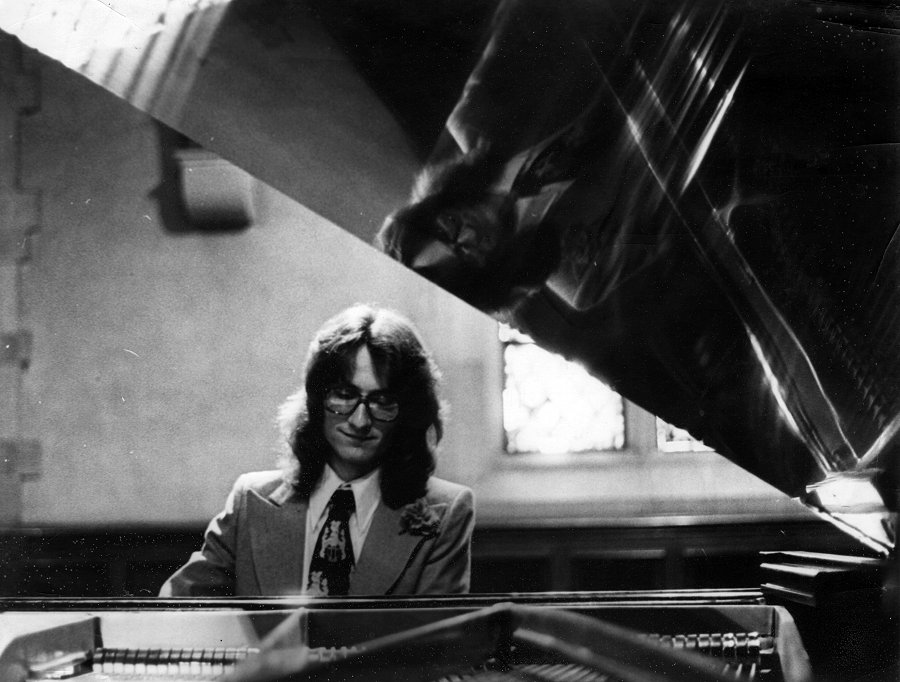
Senior Piano Recital, Park College, Parkville Missouri (April 16, 1978).
After graduating from college in May 1978, I briefly visited the Maharishi University in Fairfield, Iowa, to check out the scene, but was sorely disappointed; the students there dressed in conservative shirts and ties and wore short hair cuts. I thought they looked a little like fundamentalist Christians. I was looking for something more radical; something less mainstream; something more austere.
By chance or by the design of a higher power, on the way home driving my father’s 1963 Ford pickup truck from Kansas City to New Jersey with my sister Cindy in July 1978, I visited a former high school buddy and chess player (Kenneth Rozyahegyi) who that year happened to have a summer job teaching art at a summer camp in Wheeling, West Virginia. While sitting in his barren, hot and stuffy apartment with nothing to do, he suggested, “Why don’t we visit the nearby Hare Krishna community; they’re building a palace for their founder. I’ve been there before; it’s really cool!”

Henry (c. age 17) plays his 16-year-old friend Kenneth Rozyahegyi during lunch hour at Saint Peter’s High School, New Brunswick, New Jersey (c. 1973). Yikes! It looks like Ken is about to capture my queen! We must be playing Loser’s Chess. Photo by Steve Nagy.
Kenny and I (and my sister Cindy) spent the afternoon touring New Vrindaban and I was impressed. I found a community of spiritual seekers who seemed to practice what they preached: renunciation. The single men slept for only six hours each night in sleeping bags on the floor of an ashram with twenty or thirty others; they took ice cold baths (there was no hot water)—without even using soap (as far as I could see)—in the communal bath house. The toilets were only holes in the concrete floor (Indian style) without even doors on the front of the stalls!
The New Vrindaban devotees chanted Sanskrit mantras for two hours daily, usually attended two temple services daily (and sometimes three on Sundays), worked at least eight hours daily for Krishna without remuneration, ate only vegetarian food offered to Krishna, and spoke nothing except topics about Krishna or Krishna’s service.
One of the devotees remained perpetually silent except for the words “Hare Krishna” which he would sometimes unexpectedly and loudly shout. Another devotee stubbornly refused to wear socks or shoes, even in winter. His feet were heavily calloused and pitted with deep cracks which reminded me of the canals on the surface of Mars. These people obviously were serious about minimizing bodily needs. They were tough; like the Marines. Hare Krishna seemed to me to be the elite “Green Berets” of all the Indian spiritual movements. And the philosophy appeared undefeatable. This is what I wanted: a challenge.

Prabhupada’s Palace under construction.
About a month later in August 1978, I visited the community again during a drive to North Texas State University (where I had been accepted as a piano major in their graduate music school) and met Kirtanananda Swami for the first time. I was immediately drawn to the warmth and kindness which seemed to radiate from him. He appeared to express genuine concern for me and I listened to him speak as a respectful son listens to a wise and compassionate father. Maharaja gave me a personal tour of the community and urged me to stay at New Vrindaban and focus on my spiritual life, instead of continuing my journey to Texas. I argued with Maharaja; yes, I was interested in learning more about Krishna consciousness, but I also had no intention of abandoning my music studies. Why could I not do both? After some time in intense discussion, Kirtanananda finally forced me to admit defeat by paraphrasing a verse from the Bible, “What is the use of becoming the greatest musician in the world if you lose your immortal soul?”
I recognized the value of pursuing spiritual studies, and decided on the spot that it wouldn’t hurt to put graduate school on hold for a few months and spend the rest of the semester testing the Krishna consciousness Bhakti-Yoga program under Maharaja’s tutelage. I liked chanting the mahamantra, I liked a vegetarian diet, and I liked sleeping on the floor and living simply in a community of like-minded souls whose motto was “Plain Living, High Thinking.” After all, I thought, I could always resume music studies again five months later in January, if I decided living at the Hare Krishna commune was not to my liking.
We were taught that when you surrender to Krishna, you must surrender all your possession. I had a brand-new vehicle, a yellow Ford van, which my father had purchased for me as a college graduation present. I also had my accordion, and a large collection of piano music and classical music long-play 33-rpm records. I did not give my van outright to the community, as I knew my father had purchased the vehicle for me so I could drive from New Jersey to North Texas State University for Graduate School studies. If I wasn’t going to need the van, I should return it to him. However, I let the community borrow my van, at least until I returned it to my father in the future. Bhokta dasa (Robert Bauer) used my van to drive from New Vrindaban to Pittsburgh on his bhoga runs to purchase produce for the New Vrindaban kitchens at the Pittsburgh produce markets. He put on hundreds of miles on the brand-new vehicle.
After a week or two living in the men’s ashram at Bahulaban, I was invited to move up to the brahmachari ashram at the isolated Vrindaban farm. I worked at the Palace-under-construction, gold leafing the capitals on the columns in the kirtan hall. I also did some gold leafing on the concrete balusters on the perimeter of the Palace roof. I chanted sixteen rounds daily, attended the temple programs, ate only Krishna prasadam, strictly followed the regulative principles and suffered terribly.
Going “cold turkey.”
My first months at New Vrindaban were incredibly difficult, due in large part to withdrawal from the object of my affections: classical music. During college I had performed with symphony orchestras, sang Handel’s Messiah with a huge 280-voice choir, and even performed a leading role in a concert performance of Puccini’s opera Madame Butterfly. I had composed original music for musical theater productions and directed pit orchestras. But that was all over now. Finis.
From hearing Bhagavad-gita and Srimad-bhagavatam classes I technically understood that most music was simply sense gratification: a highly pleasurable activity which distracted the soul from God and entrapped the living entity in Maya’s illusory energy. But God! how difficult it was for me to shed my addiction to classical music! My intellect insisted that I should stay at New Vrindaban, shed my material desires and develop my dormant love for God, but my heart sorely missed the thrill of composing, performing and listening to classical music; the excitement, the glamour, the acclaim, the intellectual satisfaction and the rapturous beauty of the passionate melodies, harmonies and rhythms which had captivated my consciousness for so many years.
Building Prabhupada a palace.
I clearly remember working at Prabhupada’s Palace-under-construction, probably in October 1978, doing some solitary gold leafing in the central Kirtan Hall, crying out in despair from the pain of my mental and emotional anguish and mournfully singing in a loud voice the mahamantra (great chant for deliverance): “Hare Krishna, Hare Krishna, Krishna Krishna, Hare Hare; Hare Rama, Hare Rama, Rama Rama, Hare Hare” to the tune of the plaintive Jaya Radha Madhava melody which was sung every morning before the daily Bhagavatam class. I put my entire heart and soul into that chanting; I was suffering so much. I begged Krishna, “Please help me! Please save me! Tear out my material desires from my tortured heart and heal it with unconditional ecstatic love for you!”
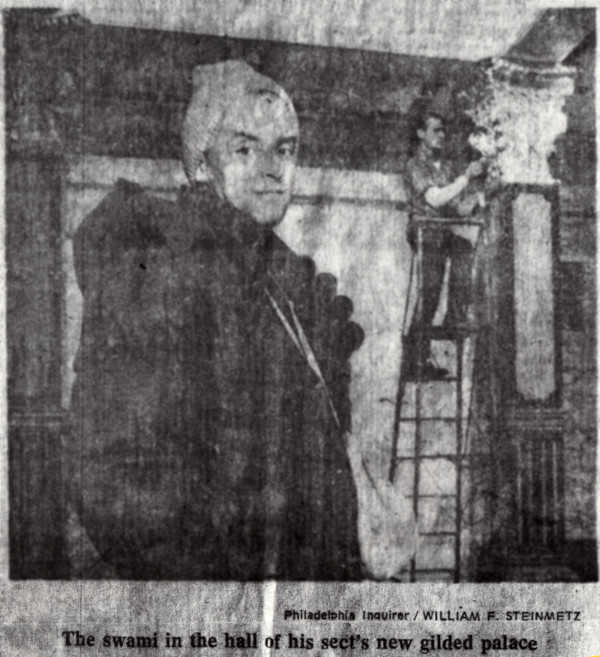
Kirtanananda Swami at Prabhupada’s Palace-under-construction. The author appears in the background applying gold leaf to a Palace Kirtan Hall column capital (Philadelphia Inquirer photo, c. October 1978)
I freak out.
This act of calling out to Krishna in my moment of despair frightened me severely. I could see that the process of Bhakti Yoga as practiced at New Vrindaban was working: I was becoming attached to Krishna. Chanting sixteen rounds daily, attending all the temple programs, eating only Krishna prasadam, sleeping little, associating only with Krishna devotees and avoiding the company of nondevotees such as family and friends, was slowly but surely having an effect: I was gradually developing love for Krishna.
But who was Krishna? I had seen no proof, or even evidence, that Krishna is God. How do I know that Krishna wasn’t just a mythological figure like Zeus, or Odin, or the Loch Ness Monster, or the abominable snowman, or Santa Claus? It was all based on ancient scriptures such as Bhagavad-gita and Srimad-bhagavatam, scriptures which claimed that they were the very words of God. Yet, didn’t the Christian scriptures, and the Muslim scriptures, and the Mormon scriptures all say that they were also the word of God? What makes Krishna any different than Jehovah, Allah or even Santa Claus? They all make outrageous claims without offering any proof. The devotees told me, “Because this book says that Krishna is God, so that means Krishna is God.” All circular reasoning.
My doubts increased tremendously, and I made a collect call to my home in New Jersey from the phone outside the Bahulaban front office. My mother answered the phone. I told her to come to West Virginia and pick me up and take me home as soon as possible. I told her I was becoming brainwashed. I said, “When you come to get me, if I say I changed my mind and want to stay in West Virginia, you should forcibly take me back to New Jersey, just in case my brainwashing becomes complete.” I was that much afraid of becoming Krishna conscious. Perhaps, I thought, I should investigate a monastic order of Roman Catholic monks. They are also celibate, and perhaps their path may be better for me than this foreign Hindu path.
My mother took a moment to consult with my father, and replied, “We can’t come get you this weekend, nor next weekend, but we could make the trip the following weekend.” This was not good news to me, but I figured I’d have to wait. I could have hitchhiked back home, but I never liked hitchhiking. In retrospect, I could have demanded temple authorities to return to me my van, and then I could have simply driven to New Jersey and been home in eight hours. But for some reason or other, that thought did not occur to me.
Soon after this phone call with my mother, I was taken off the gold leafing crew, and ordered to assist Kamsahanta Prabhu, a Prabhupada disciple initiated in Toronto in March 1974, who at the time was designing the art for the perimeter of the ceiling of the Kirtan Hall at Prabhupada’s Palace-under-construction. Kamsahanta’s sister Annie claimed her brother was “a brilliant artist, a phenomenal artist. . . . He went to South Africa. They built a Krishna temple in South Africa and he helped design it. He’s a phenomenal artist. And he can sing, as well.”
Kamsahanta showed me how to create stencils and trace them up on the ceiling. We worked on our backs on a high scaffold. After tracing the stencils, which included floral vine designs and a symmetrical mandala design, we used fine paint brushes to paint the patterns inside the stencil lines. We used pink, green, dark purple and black paint and added gold leaf in the spaces between the square and rectangular shapes.

A section of the perimeter of the ceiling in the Kirtan Hall of Prabhupada’s Palace-under-construction. The author began work on this project in October 1978 and completed it in March 1979.
However, after a few days, Kamsahanta blooped (defected from New Vrindaban) and I felt I was the only one who could complete the project. I became absorbed in my service, laying on my back on a scaffold and stenciling designs on the ceiling of the Kirtan Hall, then painting and gold leafing the patterns. It was intricate and painstaking work, but I liked it.
And I enjoyed a side benefit: although the winter of 1978-1979 was very cold in West Virginia, the ceiling of Prabhupada’s Palace was heated by resistant electric wire coils in the ceiling and under the marble floor. Heat was generated by the passage of electric current through a resistor through a process known as Joule heating.
I do not like winter and I do not like to be cold, but working on that scaffold was a delight, with the heat radiating from the ceiling only a couple feet above my body. I kept a steel bowl filled with water by my head, and I splashed it on my face whenever I became drowsy. I felt I was nearly always sleep-deprived, living at New Vrindaban.
After a week or two, I became absorbed in my service and decided maybe practicing Bhakti Yoga at New Vrindaban was okay. Maybe Krishna is God and maybe he isn’t, but my doubts were dispelled by the pleasure of my service. I felt I was doing something important for Prabhupada. Perhaps Krishna made Kamsahanta bloop so that I would stay at New Vrindaban.
My parents and brother come to New Vrindaban to take me home, as I had requested.
When my family came to pick me up sometime in November 1978, I had already had a conversion experience, and told them that I didn’t want to come back with them to New Jersey. I had become quite happy living at New Vrindaban, and I felt a responsibility to complete the project which Kamsahanta had started. My mother, however, was not about to let me stay at the Krishna commune cult. We argued for a while in front of the Bahulaban temple building. Achyutananda Swami was there, also arguing with my mother.
Suddenly Kirtanananda Maharaja walked by, and my angry mother began harassing him. Kirtanananda told her, “Your son can leave at any time!” but she kept on verbally harassing him. I began to get worried. My mother was offending a pure devotee of the Lord, and she would have to suffer a negative reaction for her actions. Suddenly, I interrupted and suggested, “I’ll tell you what, mother. I’ll come back home for a month, if you first stay here for a month!” I thought that was a clever compromise; perhaps if she stayed at New Vrindaban for a while, she’d get purified, and maybe she’d become a devotee too!
My mother agreed. My father was so upset that he went to my van, hopped in, and started driving back to New Jersey. My brother John followed my father and drove my parents’ vehicle back. After they departed, I spent some time with my mother, got her some prasadam, and asked one of the New Vrindaban women to find her a place to spend the night. They put her up in one of the apartments on the second floor of the Bahulaban barn. I walked back to the Old Vrindaban Brahmachari Ashram, where I had been living already for a couple months.
After the Morning Program (and breakfast: rice and oatwater) was finished, I walked back to Bahulaban to check up on my mother. Temple administrators told me she had already left. She borrowed some money from the front office, got a ride to Wheeling, and purchased a bus ticket to New Jersey. Years later, she told me, “The room they gave me in the barn was infested with cockroaches. I was very uncomfortable. I prayed all night, what to do, and I received an answer: Go back to New Jersey. So I did. I’m glad I did.”
The Christmas party at my parents’ house.
One month later, New Vrindaban authorities gave me permission to visit my family and friends in New Jersey for Christmas, but as a precaution to help insure that I would return to West Virginia, they sent a fixed-up Prabhupada disciple, Sankirtan Prabhu (Andy Frankel, the head of the New Vrindaban Theater Department and one of the cooks in the Bahulaban Pits), to come with me as a chaperone. We had a nice visit, and some of my high school friends, such as Eugene Rodek, one of my buddies on the St. Peter’s High School Chess Team, came to see me.
I think my 74-year-old piano teacher also came to our party, although it is more likely that I went to visit him at his Highland Park, New Jersey apartment. His name was George Huddleston, born September 26, 1904 in Fulton, Kentucky. When he was a teenager he made money by playing the theater organ during silent films. He studied piano and organ at the University of Louisville. George Huddleston served as organist and choir director at the historic Christ Episcopal Church at 5 Paterson Street in New Brunswick (opened in 1750) for 44 years, from 1930 until he retired, at age 70, in 1974.
I studied piano with him for about two years, from age sixteen until eighteen, probably 1972-1974. I learned to play J. S. Bach’s Two-Voice Inventions, Bach’s Partita No. 1 in Bb, Debussy’s Arabesque No. 1, and Robert Schumann’s Kinderszenen Op. 15, among other works.
Mr. Huddleston was bisexual (which I discovered later) and during my piano lessons he sometimes talked about sex. This was something new for me, as no one else talked with me about sex, being raised in a strict Roman Catholic family and attending Roman Catholic schools since first grade. I got the impression that sex was very, very bad, except perhaps in the Sacrament of Holy Matrimony.
Once, our Parish priest, Reverend Father Francis J. Dwyer (c. 1907-1986), spoke to my eighth grade Our Lady of Lourdes School class about sex. (The girls were asked to leave the room and they went to another room where one of the senior nuns talked to them about sex.) We were all quite uncomfortable, and I think Father Dwyer was also.
Actually now that I think about it, there were a couple boys in my Boy Scout Troop 28 who sometimes talked about sex. I remember a poem one boy recited to me: “Close your eyes, spread your legs, let me fertilize your eggs.”
Once Mr. Huddleston told me about one of his male students, a college student, who had complained to Mr. Huddleston that every time he was in bed with his girlfriend, he’d “shoot off his wad” (Mr. Huddleston’s words) in 30 seconds before the girl even got aroused. The boy, he said, was frustrated, as was his girlfriend. Mr. Huddleston told me, “I told him to masturbate before going to bed with the girl, and he told me his premature ejaculation problem was solved.”
Another time, Mr. Huddleston praised older women as sex partners. He told me, “They don’t swell, they don’t tell, and they’re horny as hell.”
While speaking with Mr. Huddleston in December 1978, our conversation turned to sex (I was not surprised), and I told him that I had rejected sex and now was a practicing celibate monk. Mr. Huddleston asked, “Do you have wet dreams?”
Yes, I had nocturnal emissions two or three times a week, but I didn’t tell him that. I lied and told him, “No,” as I wanted to show off the alleged superiority of my Gaudiya Vaishnava religious practice. Mr. Huddleston replied, “Perhaps it has something to do with your vegetarian diet.” Already, after only four months at New Vrindaban, I began lying to people to defend my religion. It was not a good sign and this trait increased as time passed.
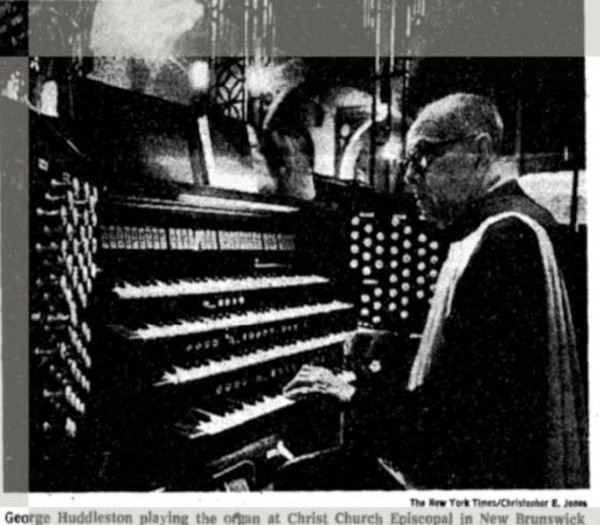
George Huddleston at the console of the Æolian-Skinner opus 1315 four-manual organ at Christ Episcopal Church. At that time the instrument had 25 speaking stops. Image from New York Times (September 22, 1974).
My college girlfriend also was there at our Christmas party, Claudia Stoutenburg, who graduated from Park Hill High School in Kansas City, Platte County, Missouri, in 1970. I liked her a lot, but after living at New Vrindaban for four months, I had become truly afraid of her, as I had become a staunch brahmachari. At New Vrindaban I was taught that attractive women were very dangerous; like tigers and witches.
At the party at my parents’ house, Claudia asked me to follow her into a bedroom so she could speak to me privately, without other people around. I told her she should come to New Vrindaban, chant Hare Krishna, become a devotee, and we could get married, but that plan did not appeal to her. I gave her a hug, and during our close proximity I noticed an immediate stiffening of my resolve. “This is not appropriate behavior for a brahmachari,” I thought, and I broke off the hug. I heard she drowned a few months later while scuba diving in the Atlantic Ocean. Her parents came from Kansas City to New Jersey to help plan the funeral, and they stayed in a spare room at my parents’ home.
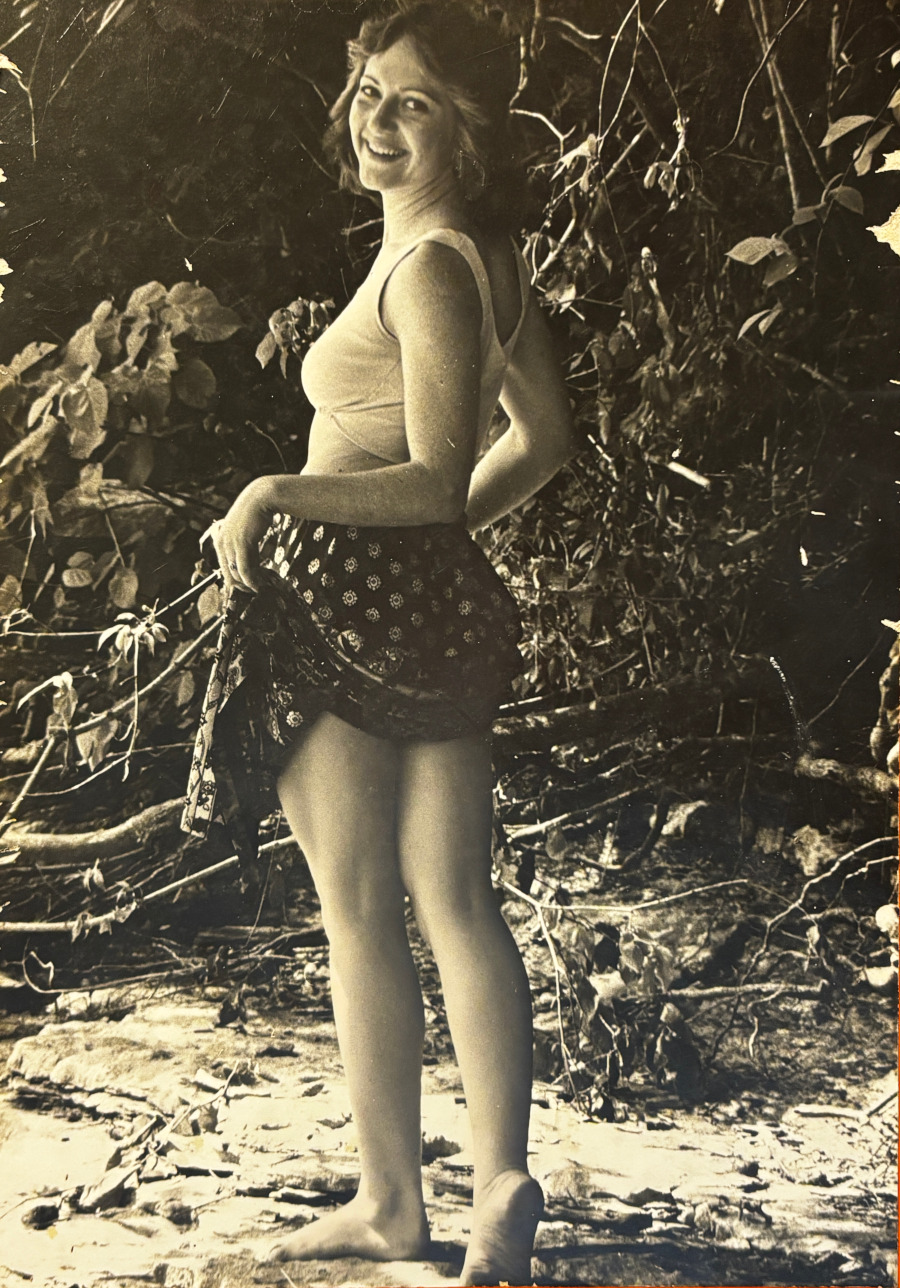
My college girlfriend, Claudia Stoutenburg (c. 1974).
Years later, I described my conversion experience: “Sometime shortly after [Kamsahanta blooped], apparently by the grace of guru and Krishna, I acquired a taste for devotional service—seemingly overnight—and my mental tempest dissipated like the thick New Vrindaban early-morning fog which is burned off by the rising sun. I had a change of heart (a conversion experience), and decided maybe there was something of value worth pursuing at New Vrindaban. I dived in head first and didn’t look back. I became infected with the Brijabasi spirit and faithfully served Kirtanananda Swami’s mission at New Vrindaban for more than fifteen years. I became emotionally attached to my spiritual master and performed (sometimes) great austerities to please my master by my service.”
I requested initiation from Kirtanananda Maharaja: “I would like to become your disciple and spend the rest of my life serving Krishna here at New Vrindaban.” Maharaja beamed joyfully and exclaimed, “Jaya! That’s what I like: someone who comes and does not run away.” (“Jaya” or “Jai” is a Sanskrit exclamation designating approval, often translated as “victory.”) I was initiated on March 13th (Gaura Purnima), 1979, and received the name Hrishikesh dasa (servant of Krishna, who is the master of the senses).
As I had sacrificed a great deal (a potentially promising career in music) to live at New Vrindaban, I decided to give the process a fair chance: I faithfully chanted sixteen rounds daily, strictly followed the four regulative principles, scrupulously attended all the required spiritual programs, resided with similarly-minded godbrothers at the remote Old Vrindaban brahmachari (celibate male student) ashram, and worked to the best of my abilities to help build a ornate memorial shrine for the late founder and acharya of the International Society for Krishna Consciousness: A. C. Bhaktivedanta Swami Prabhupada (1896-1977) who had passed away only nine months before I came to live at New Vrindaban.
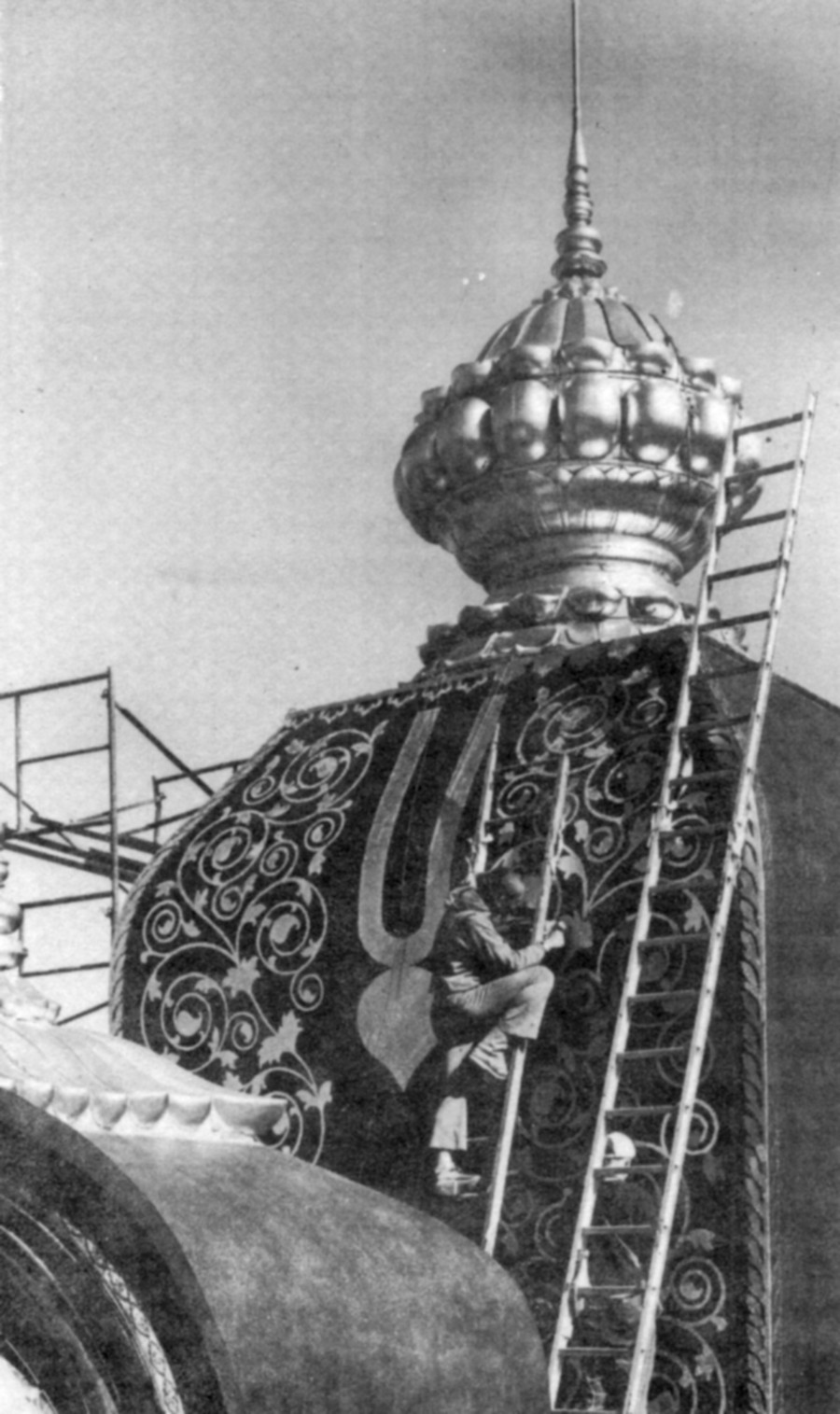
The author applies gold leaf to the Palace dome (Summer 1979). Photo enhanced and colorized by AI.
The hidden, inner reasons why I joined New Vrindaban.
Decades later, I began to understand little by little more of the hidden, inner emotional reasons why I abandoned graduate music school studies and surrendered to Kirtanananda Maharaja at New Vrindaban. Yes, I was certainly interested in Hindu spirituality, but that is only part of the story of my conversion. Factually, in 1978 I had reached a stage in my life where I was confused, unhappy, and stricken with self doubt. In such a paralyzing mental state, a person can easily become a victim of a charismatic cult leader who promises eternal happiness if the novice surrenders to him. Happy people generally don’t join charismatic cults. Unhappy people do. In my case, three factors figured prominently in my conversion:
(1) I began to realize that I would never become a great concert pianist. In high school and college, I was something like a big fish in a little pond. I had some musical talent and ability beyond my peers, but if I had attended a big university instead of a small college, I would have seen my humble position very quickly, amongst dozens of really great piano students who might have begun studying piano as early as four years of age. I didn’t start piano studies until I was 16, therefore my skills were substandard, although I didn’t realize this until my senior year of college.
Prior to that, I had unrealistic and impossible fantasies: for a long while I thought that in time I could learn to play piano as well as Franz Liszt and compose as well as Ludwig van Beethoven. The sky was the limit. I really believed that. I was young, idealistic and foolish.
During my senior year, my piano professor, Robert C. Anderson, suggested I play a movement from the Mozart Piano Concerto No. 20 in D minor at a Master Class for college and university music students hosted by Maestro Maurice Peress and the Kansas City Symphony, and sponsored by the Kansas City Regional Council for Higher Education. When it was my turn to play, I sat at the piano and waited for the orchestra to finish the long two-and-a-half minute introduction.
However, when I started playing, I became afflicted with stage fright. My fingers and composure became unsteady, but I pushed on. When the difficult rapid piano passages came along, I fell behind the orchestra, and Maestro Peress stopped the musicians. We continued again from my entrance, but once again I was unable to keep up the tempo during the fast passages. Finally Maestro Peress stopped again, thanked me, and said that will be all. I was terribly humiliated.
The same scenario played out again a few months later in January 1978 when I flew to Rochester, New York to audition as a piano major at Eastman Graduate School of Music, one of the great conservatories in the United States, founded in 1921. During my audition, once again I got stage fright and played terribly. This was a great blow to my ego. For several years I had hoped to become a superb classical pianist, but I realized that was not going to happen. This was very depressing to me.
To make matters worse, although I was accepted into North Texas State Graduate School of Music as a piano major in the autumn of 1978, solely on the recommendation of my college piano professor (I did not audition), I did not have a scholarship. How was I going to pay my tuition? In retrospect, it seems crazy that I began a 1,576-mile drive from East Brunswick to Denton Texas to study music without knowing where my funding was coming from.
(2) Another, perhaps greater blow to my ego, was due to my relationships with women. I suppose I was a late bloomer, as I had my first intercourse with a woman during my sophomore year in college at the age of 19. For the next three years, I dated perhaps a dozen women, although my relationship with Claudia Stoutenburg (mentioned earlier) was the longest lasting. Yet during those college years I never dated a woman who I wanted to spend the rest of my life with.
In 1977, during the autumn of my senior year, I met a beautiful 17-year-old freshman woman with a gorgeous figure, cute face and long black hair. I fell in love with her, but I still didn’t want to marry her. All these women were beautiful and sexy: but they did not share my intellectual passions. During my four years of college I did not meet anyone who could capture my mind with her intellect. I have since discovered in order for me to be faithful, a woman has to captivate my mind. After a few months, the black-haired freshman, realizing that I wasn’t going to marry her, broke off our relationship, and began dating a percussionist (Doug Gourley) in the music department. I was devastated.
Soon after, I had the opportunity to go to bed with two young women I had liked for a long time: a very cute young lady in my graduating class from Torrance California (Katie Peterson) and an upper class-woman (Laura Eckels). But when we got into bed, my male organ refused to cooperate, perhaps due to unknown psychological reasons. This had never happened before.
My erectile dysfunction was extremely embarrassing, another great blow to my ego. Perhaps that is one reason why I gravitated to a cult which emphasized celibacy. If I can’t find a suitable mate, I thought, then perhaps I should give up on my futile quest and become a monk.
Later I discovered that stage fright and erectile dysfunction are related: both are examples of performance anxiety—an intense fear of failure or negative evaluation when your abilities are watched by others. Common triggers include: public speaking and stage performances, job interviews and work presentations, athletic competitions and exams, and sexual intimacy.
(3) A third factor is also important: Why was I so attracted to Kirtanananda Maharaja the first time I met him? I would never have joined the New Vrindaban Community except for him.
Decades later, I began to understand more about the mechanics of my love for Kirtanananda, and that has a great deal to do with my relationship with my own father. My father (1929-2023) was a great guy and a good provider for his family, and we both loved camping, canoeing and hiking. He was a superb scoutmaster when I was in the Boy Scouts of America, but in some ways we were very different. He loved gardening. His garden was his pride and joy.
On the other hand, I was not interested in gardening. When my father asked me to come help him weed the garden, I would run and hide. I liked reading books about science and science fiction, and I liked playing music. I think he was disappointed I did not want to help him in the garden, and I could tell in many subtle and not so subtle ways that I was not the son he wanted. When I practiced my accordion, no matter how well I played, if a finger hit a wrong note, he (and my mother) would say, “You made a mistake.” I felt no matter how good I was, I was never good enough.
This frequent criticism left a void in my heart; a void which was later filled by a charismatic cult leader: Kirtanananda Swami. During fifteen years in his service at New Vrindaban, Maharaja hardly ever criticized me; he always encouraged me with kind and loving words. He was the father that I wished I could have had when I was a child.
Kirtanananda, unlike my father who dropped out of high school at the age of 16 to work on a farm, was educated, intellectual and artistic. He appreciated classical music, he worked as a church organist in college, and he was a superb orator and debater. He loved to discuss philosophy, and I felt a sincere warmth radiating from his heart. Kirtanananda became something like a foster father for me. This is why I could surrender to him to the great extent which I did.
I became a devotee not because of Krishna, or the Vaishnava philosophy, or the Hare Krishna chanting, or Bhaktivedanta Swami Prabhupada’s books (to be frank, I thought his books rambled on in a confusing and disjointed manner, and I never even finished reading his Bhagavad-gita in full). I became a Krishna devotee because of my admiration for my spiritual master, Kirtanananda Maharaja, which in a few years was gradually transformed into a deep heart-felt love.
The Pick.
In October 1979 I worked a big event in Chicago, “The Pope Pick,” and excelled at selling buttons with the image of Pope John Paul II. This was my first time collecting money for New Vrindaban, and I was, amazingly, the top men’s collector at the event. Thereafter I was sent to the ISKCON temple in Cleveland, Ohio, to learn how to distribute Prabhupada’s books. At first I was terrible. But I doggedly continued in this service, as my spiritual master said sankirtan is the highest service.
Somehow or other, I think in the summer or autumn of 1980, I suddenly discovered how to do this service of collecting money, and a year later, in December 1981 at the Christmas party following the Christmas marathon, I won an award for being the top men’s collector that year. I enjoyed the praise I received from my spiritual master, my godbrothers and the other New Vrindaban residents.
I excelled at this service of picking for several years, but, beginning in 1984, I began to develop some physical weaknesses which greatly reduced my stamina and collections. I was unable to regularly do big on The Pick anymore because my body had lost much strength, I believe, partly from the stress of the service itself as well as our customary abuse of and disregard for the body’s needs. Now I will tell the story about my life on The Pick.
To be continued.
| Back to: Gold, Guns and God, Vol. 4 |