
Nara Narayan dasa (2022).
Nara Narayan dasa was born Nathan Baruch Zakheim on December 20, 1943, the son of a famous Hasidic Jewish muralist: Bernard Baruch Zakheim (1898–1985). [Endnote 1] His mother, Phyllis Wrightson Zakheim from Berkeley California (1907-1998), was an artist in her own right who exhibited watercolors and oil paintings at the World’s Fair on Treasure Island and the San Francisco Museum of Art.
Bernard Zakheim, was originally from the city of Warsaw in the Russian Empire (today Poland), and fought in World War I. His grand daughter, Juliana explained, “Bernard had left Warsaw before things went bad, he was in France and fought in the French army. He was captured twice, and escaped both times.” [Endnote 2]
After the war, Bernard immigrated to the United States in 1920 and settled in San Francisco. He was a Polish-born American muralist, sculptor, and outspoken social-realist artist best known for his 1930s New Deal–funded public art in San Francisco, including the Coit Tower and UCSF’s History of Medicine in California murals.
Trained in Poland and influenced by Diego Rivera, he merged expressionist style with political themes, often depicting Jewish heritage and social justice. His works are held in major institutions and remain notable for their cultural and historical resonance. Zakheim’s work is in the collections of the San Francisco Museum of Modern Art, Brandeis University and the Jewish Historical Institute in Warsaw, and is archived at the Smithsonian, Stanford, UCSF and UC Berkeley, among other institutions. Bernard’s two sons became art restorers, and his two daughters furthered his art through writing and publishing. He has his own website, and Wikipedia page.
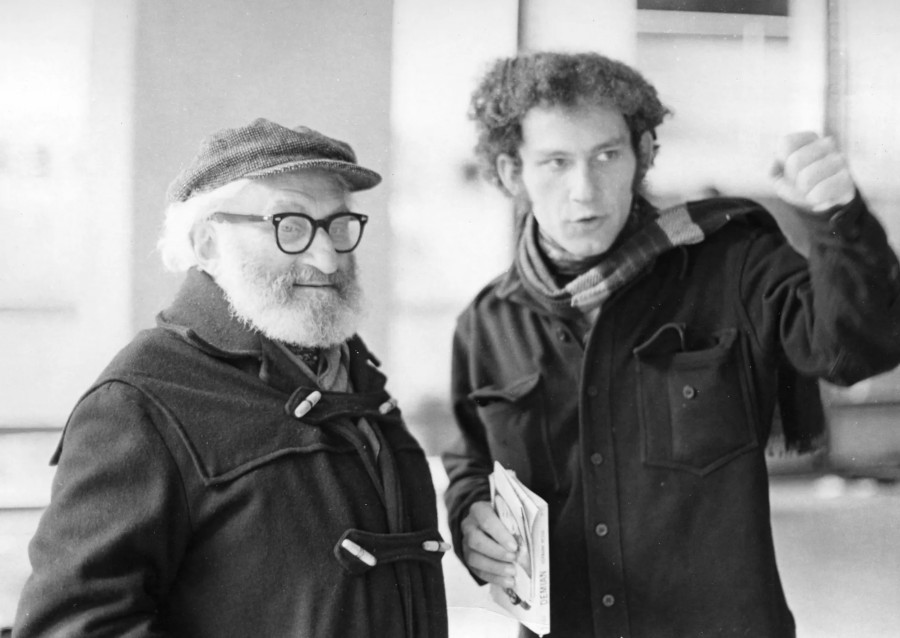
Bernard Zakheim with son Nathan in 1967 discussing mural removal and restoration at UCSF. (Photo/Courtesy UCSF Archives & Special Collections)
Bernard Zakheim’s eldest son Nathan grew up on an apple farm in Sebastopol in Northern California and received a Bachelor in English degree from San Francisco State University in 1966. He became an aspiring musician in the 1960s Haight-Ashbury hippie scene, but damaged his ears when he attended a psychedelic rock concert while stoned on marijuana. He became partially deaf from standing too close and too long near the speakers. After this, Nathan became hard of hearing. Soon after, he joined ISKCON in San Francisco. Nathan’s younger brother Matthew (1945-2020) also joined the Hare Krishna movement. [Endnote 3]
At the age of 24, Nathan received diksa and the name Nara Narayan dasa on September 20, 1968. Nara Narayan became known in ISKCON for his artistic work: sculpting deities, designing and constructing Ratha-Yatra carts and temple rooms, and serving as Art Director for the Bhaktivedanta Book Trust from 1975 to 1980, as noted in his résumé. As early as 1969, Bhaktivedanta Swami Prabhupada conferred upon him the title “Vishvakarma” (the presiding deity for artisans and architects) in recognition of his service. In Los Angeles in 1975, he received the ISKCON Bhakti Shastri certificate.
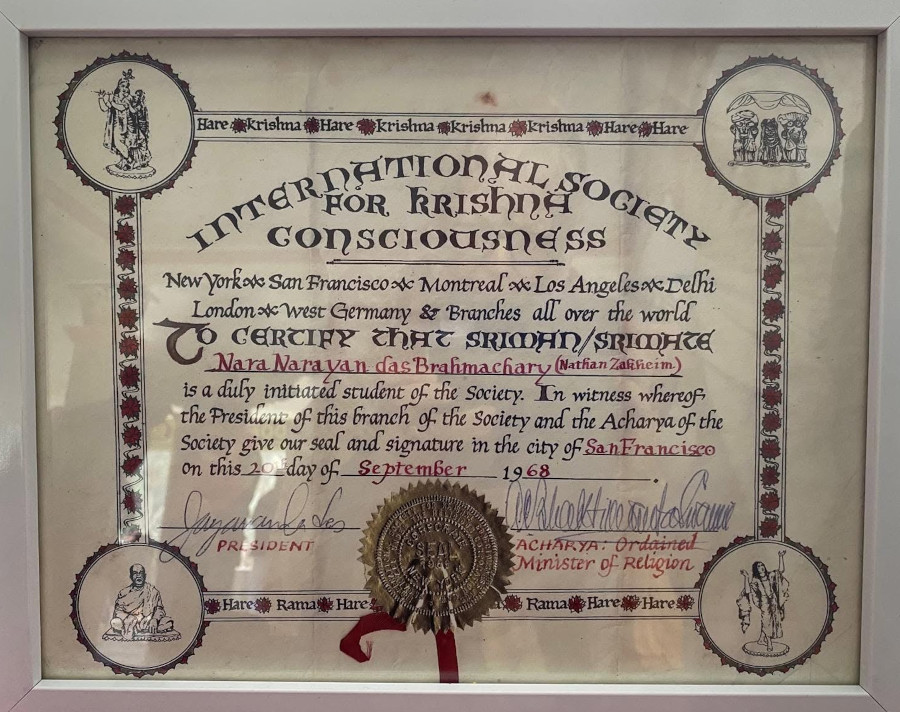
Certificate of Initiation for Nara Narayan das Brahmachary, signed by San Francisco ISKCON temple president Jayananda das and Acharya, Ordained Minister of Religion, A. C. Bhaktivedanta Swami (September 20, 1968).
Nara Narayan visited New Vrindaban in 1968 and lived there on and off in 1969 and 1970. He lived at Pittsburgh ISKCON in 1970 and carved from a huge New Vrindaban log the giant 51-inch-tall Jagannath deity which currently resides at New Vrindaban. After Bhaktivedanta Swami Prabhupada passed away in November 1977, and the eleven zonal acharyas took over ISKCON, Nara Narayan became critical of the new ISKCON leaders, and often spoke his mind about them. One contemporary remembered him:
I spent a day or two at his studio near downtown Los Angeles with him and his son. Such an uplifting person he was. I also recall him in 1978 yelling at Los Angeles ISKCON leaders regarding their huge mistake of appointing the eleven gurus as Prabhupada’s successors. He was in the front yard of the house next to the main temple building at about 9 p. m., just furiously calling out whomever was there to force him outta that house. [Endnote 4]
Nara Narayan authored and distributed extensive historical commentaries arguing for the strict implementation of Srila Prabhupada’s 1970 governance directives (Direction of Management), which established decentralized temple management and checks on the Governing Body Commission. He often participated in online forums and reform groups focusing on preserving Prabhupada’s original books, instructions, and historical standards without subsequent institutional alterations.
In one sense, Nara Narayan followed in his father’s footsteps and established a company, Nathan Zakheim Associates, specializing in art restoration. His company restored many outdoor murals in Los Angeles and Santa Barbara Counties and was featured in a February 1, 1980 article in the Santa Barbara News-Press. He was honored as a Fellow in the Western States Association for Art Conservation, and the American Institute for Conservation Historic and Artistic Works. He was a recipient of a Mayoral Decree from the City of Burbank, California in 2001, and was listed as a noteworthy conservator by Marquis Who’s Who.
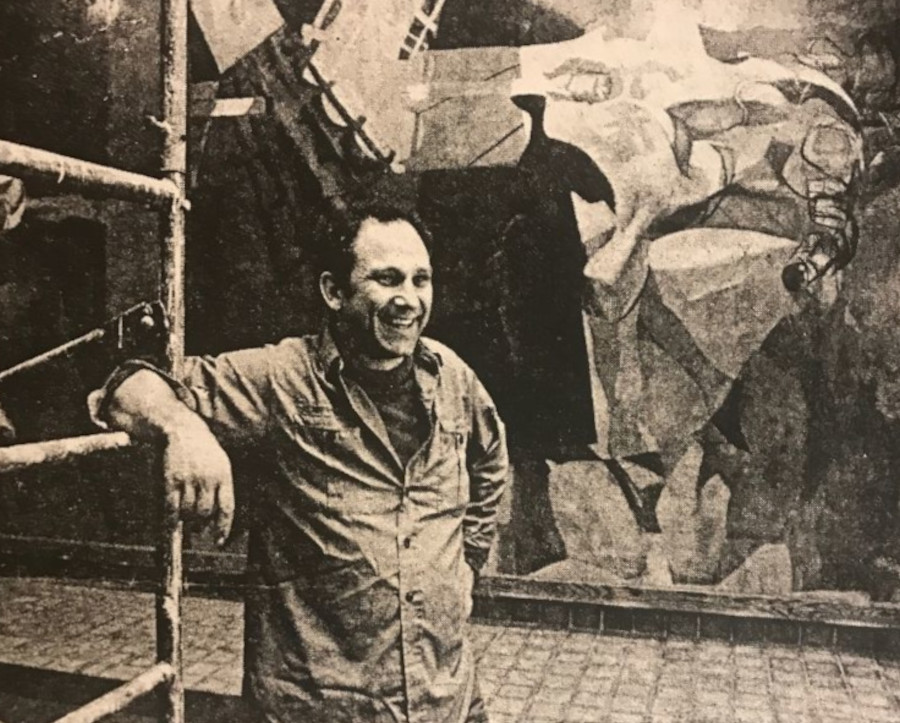
36-year-old Nara Narayan, photo from the Santa Barbara News-Press (February 1, 1980).
Although Nara Narayan and I had spoken on the telephone as early as December 2005, I only met him once, on June 28, 2017, when I visited Los Angeles ISKCON. Somehow we met, and he knew I was writing a book about the May 22, 1986 murder of his godbrother Sulochan (Steven Bryant). Years earlier, he was friendly with Sulochan and even contributed money to help Sulochan publish his book, The Guru Business.
At an outdoor patio table in front of Los Angeles ISKCON, Nara Narayan talked with me for an hour nonstop about Sulochan and his other memories of ISKCON. He was eager to share his knowledge of ISKCON history with me, and many of his stories appear in my books Killing For Krishna, Eleven Naked Emperors, and several volumes of Gold, Guns and God. I am indebted to him, as most other ISKCON devotees refused to talk to me about ISKCON history.
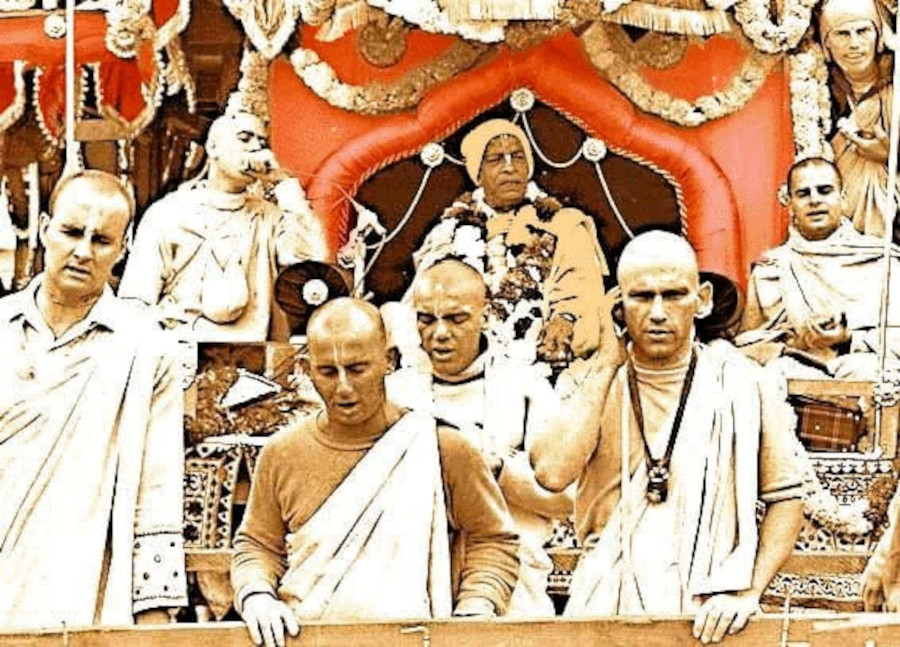
Ratha Yatra festival (undated). Left to right: Jayananda, Tamal Krishna, Bhakta Herbie, Hanuman Swami, Bhaktivedanta Swami Prabhupada, Nara Narayan, Purusottama, Hansadutta. [Endnote 5]
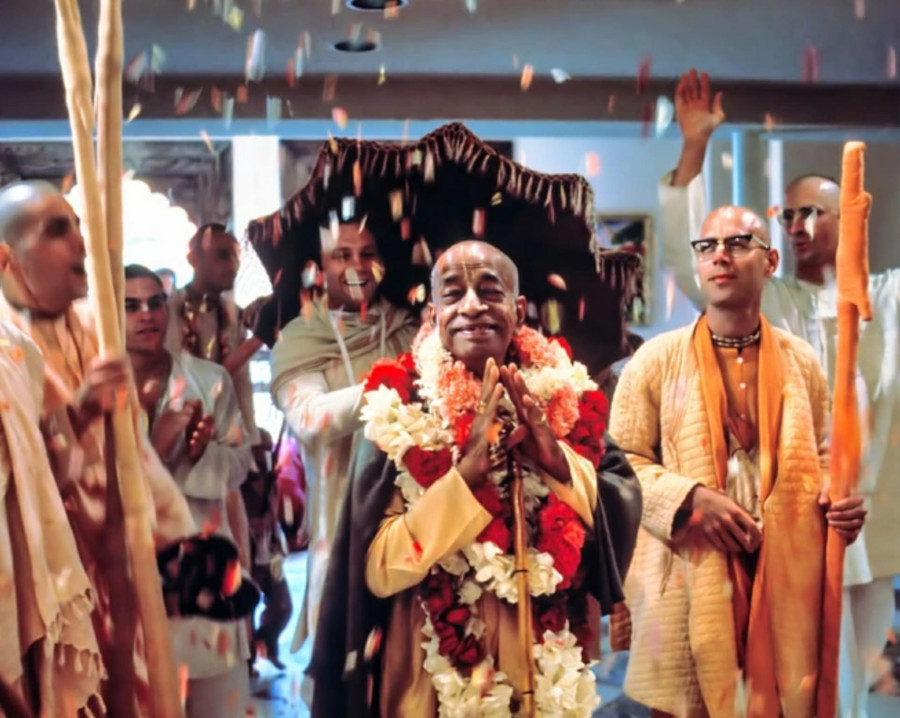
Nara Narayan holds the umbrella for Bhaktivedanta Swami Prabhupada at Los Angeles ISKCON (undated).
Over the span of a half century, Nara Narayan had five wives (three were ISKCON devotees and two were non-devotees) and a few girlfriends [Endnote 6] and he sired eight children with them, most notably Shakuntala devi dasi, the owner of Zakheim Art Conservation and co-author of the book Practical Yoga: Restoring the Body, Mind and Spirit, and his son Kuvaleshaya Dasa, who, like his father and grandfather, made a career in art restoration.
Nara Narayan’s first child was already fifty years old when his last child was born. His fifth wife had a few choice words to say about her ex-husband. In an August 7, 2026 Facebook message, she said:
There were some good things about Nathan. He was:
1) an outstanding cook; his prasadam was legendary,
2) a talented musician; he could play any musical instrument very well,
3) highly knowledgeable in the departments of literature, politics, world history, and various religions,
4) a master of any kind of repair of physical objects (primarily artwork, both two and three dimensional, and murals),
5) a great storyteller.
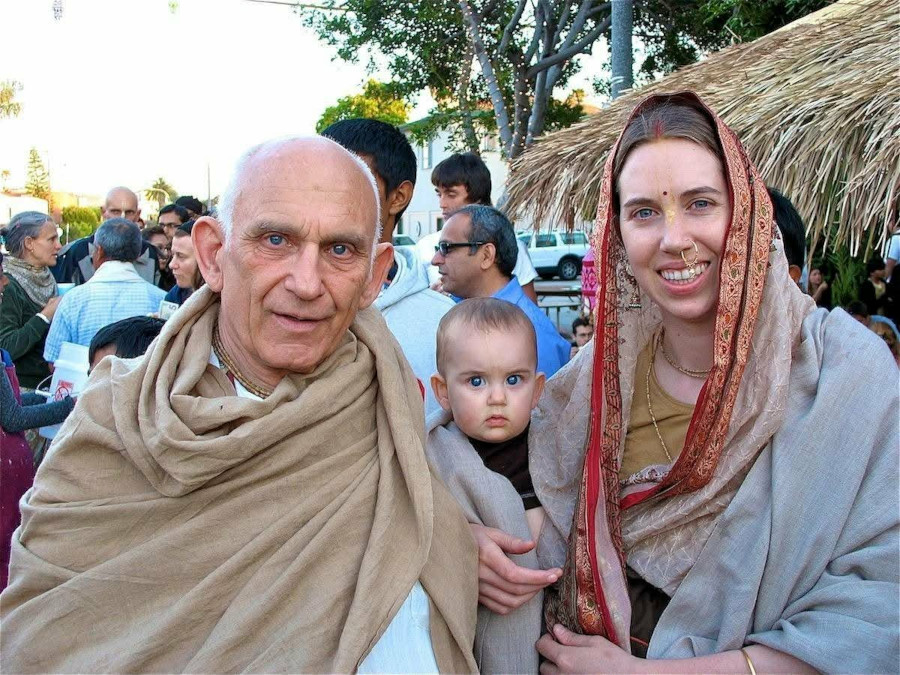
Nara Narayan with his fifth wife, nearly 40 years his junior, and eighth child at Los Angeles ISKCON (c. 2011).
Nara Narayan’s ex-wife continued:
Unfortunately, at least from my personal experience, he had a few negative qualities also. We married September 28, 2007. I was 24. He was 63. He was my first husband. I was his fifth wife, and the longest-lasting of all.
It was a very bad choice for marriage, that I was tricked into as a young and naive girl by Nathan, who manipulated me into it through the usage of Krishna conscious rhetoric, and existential guilt-tripping. It gave me a lot of suffering on many levels that took a very long time for me to recover from. It was a profound lesson as to how twisted individuals can take something great, and exploit it tor their own selfish purposes.
Nara Narayan died at the age of 79 on January 1, 2023 in Los Angeles. Dina Bandhu dasa ACBSP—a former ISKCON temple president residing in Vrindaban, India since 1984—remembered his godbrother, “Krishna has finally taken him surrounded by devotees and children at the apartments in Los Angeles doing kirtan. Srila Prabhupada nicknamed him Visvakarma for his many wonderful services including making the first very ornate Vyasasana and engineering the up and down movement of the rath carts among many. Srila Prabhupada loved him dearly and he was always a strong Prabhupada man.”
Another associate recalled, “The contribution that Nara Narayan Prabhu made in assisting Srila Prabhupada and his mission cannot be measured. From the earliest days with tools in his hand he had the energy of 100 lions.”—Bombay Narottam
Bhakta dasa ACBSP (William Benedict) remembered, “Nara Narayan was a very powerful and unique man. Eccentric, genius, and a disciple who loved Srila Prabhupada.”
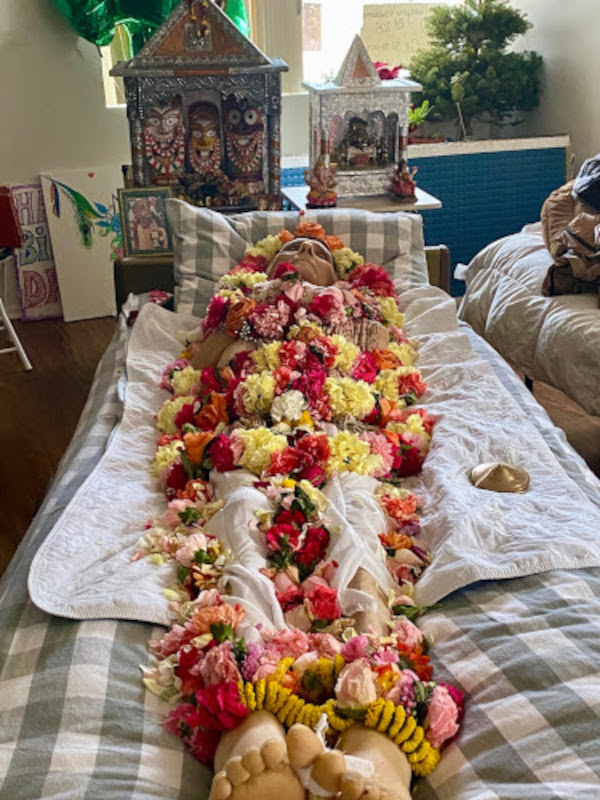
Rest in peace, Nara Narayan (January 1, 2023).
Endnotes:
1. Nathan claimed his father was born in 1896.
2. Juliana McMullin, Facebook message to the author (August 11, 2026).
3. Nara Narayan’s fifth wife explained, “Matthew took diksa two weeks before Nathan, and received the name Makhanlal (butter thief) dasa. He, unlike Nathan, remained a ‘GBC man,’ and was even favored by high-ups such as Gopal Krishna Goswami, who financed a quadruple bypass surgery for Makhanlal. Gopal Krishna Goswami also gave Makhanlal/Matthew sannyasa, and gave him the name Bhakti Madhurya Govinda Goswami.” 4. Vrindavan Brannon Parker, Facebook comment (August 9, 2026). 5. Henri Jolicoeur (Hanuman), who appears in the photo, explained, “Herbie was never initiated and was thrown out of the Los Angeles temple for drunkenness. Next to Swami Bhaktivedanta is Purusottama, who at the time was the personal secretary of Swami Bhaktivedanta. A few months later, he left ISKCON, became a Christian and told the ISKCON leaders that Jesus was real and Krishna was not.”—Facebook comment (August 11, 2026). 6. Nara Narayan had eight children, five wives and at least three girlfriends: Girlfriend CharmAnn (the mother of Nathan’s daughter Juliana McMullin, b. 1965)
Wife Dinadayadri (Jeanne Clausen, the mother of Naro Zakheim, b. 1974)
Wife Nischintya (the mother of Shakuntala, b. 1975 and Kuvaleshaya, b. 1981)
Girlfriend Stephanie (mother of Dhananjaya, b. 1983 and Kirtiraja, although Kirti is not biologically related to Nara Narayan)
Wife Nancy Zakheim (non-devotee)
Wife Eve Hands (non-devotee)
Girlfriend Lucinda Filpi (mother of Ananga Malani/Anna Filpi, b. 1986)
Wife Elizabeth Cagle (mother of Jyotir Gamaya, b. 2010 and Raya Ramananda, b. 2015)
| Back to: Gold, Guns and God, Vol. 2 |