Devamrita Swami: A Brief Biography
by Henry Doktorski (November 2026)

Devamrita Swami
October 16, 1950: On this date in history, Lee Reynolds is born in New York City. At the age of thirteen, he received a scholarship to an exclusive preparatory high school in the mountains of New Hampshire. At age sixteen, he heard progressive jazz saxophonist John Coltrane’s album, A Love Supreme, and was impressed. Coltrane’s infatuation with Indian thought and the Bhagavad-gita influenced him. Lee was impressed by the declaration on the album cover: “love of God is the ultimate goal.”
At the age of seventeen, Lee received a scholarship to attend a prestigious Ivy League college: Yale University in New Haven, Connecticut. In 1972, he graduated with an American Studies Interdisciplinary Major, essentially an independent course of study, which allowed him to plunge more deeply into subjects including world history, Western philosophy, anthropology, political science, economics, and the history of science. The dean at Yale predicted, “You are a Yale man; you will influence the world.” However, Lee had learned that the wealth and privilege of Ivy League culture, status and material influence did not guarantee inner happiness.
After graduating from Yale, Lee discovered the books of A. C. Bhaktivedanta Swami Prabhupada and was fascinated. He concluded that the knowledge presented in these books was the beginning of his real education. His attraction to this transcendental information was immediate - and the effect profound. Lee decided to abandon a corporate career in order to concentrate fully on his spiritual development. In December 1972 Lee visited the ISKCON temple in Brooklyn.
Lee joined the temple in March 1973, took diksa in January 1974, and became known as Devamrita dasa Brahmachari. On July 29, 1975, Bhaktivedanta Swami Prabhupada wrote to Los Angeles Temple President Sriman Tulsi dasa Brahmachari and accepted Devamrita dasa as a duly-initiated twice-born Brahmin. Devamrita served as manager for the Bhaktivedanta Book Trust in Los Angeles for a time. He was, however, best known for serving for eight years as an underground preacher in Soviet Europe, a service which could result in decades in prison.
For his own protection it seems, Devamrita dasa Brahmachari was married and divorced two times: once, he claimed, to a Polish woman, and later to a Danish woman. It appears that Devamrita never wore white; he always wore saffron, because these marriages were simply for show; they were arranged to allow him to legally enter certain European nations. Vamanadev dasa (Waldemar Piasecki), a Polish devotee who received diksa from Harikesh Maharaja at the ISKCON Warsaw Nama Hatta Center (December 28, 1980), and knew Devamrita dasa Brahmachari, pointed out:
Regarding Devamrta dasa: He married Krishna Bhakti devi dasi, from Almviksv Sweden, for the visa purpose as far as I know. I assume the same purpose for marriage with the Danish lady. He was never a grhastha. However, he had a habit to talk with women privately, to joke, etc. He also forced people to marry and he didn’t care for any compatibility. Afterwards, he refused to apologise for that.
I was one of best pickers, so he liked me and I liked him. Until I refused to agree to marry an unknown girl. This was his favourite pastime: to announce, after the girl (or girls) was initiated, that: you will get married soon! This soon was one week, one month or longer. In my case, I knew who was initiated and I refused. So he stopped talking to me for six months. One year later, he told me to marry once again, and this time I agreed. The girl also agreed, even though she had someone else in mind. So our marriage was never consumated and we didn’t like each other. We broke up two years later. We were living separately for one and a half years. Out of ten or a dozen marriages he arranged, think only one marriage didn’t break up.
In 1982 Devamrita took sannyasa—a lifelong vow of celibacy—from his elder godbrother Harikesh Swami Visnupada.
The Varnashram Manifesto for Social Sanity.
After Prabhupada’s passing, Devamrita co-authored a book with Harikesh Swami Visnupada (Robert Campagnola), who at the time was the ISKCON guru for Eastern Europe. Devamrita dasa Brahmachari, as a junior ISKCON devotee, did not get his name on the cover. Their 215-page book, published by the Los Angeles Bhaktivedanta Book Trust (BBT) in 1981, essentially argued that the modern, materially-based nation-state has failed and is obsolete. It proposes restructuring global human society around the ancient Vedic social and spiritual model of varnashram-dharma (organizing society into four social orders, or varnas, and four spiritual stages of life, or ashrams). In Varnashram Manifesto for Social Sanity, the two authors explained how children should be indoctrinated into Krishna consciousness:
The self-centeredness and selfishness of childhood are a form of material contamination. Young children desire to be the controllers and enjoyers of their little world. Expert at manipulating their parents by crying and smiling, young children have complete opportunity to maintain the illusions that they are their material bodies and the whole world is subject to their beck and call. Such illusions must be dealt with as soon as the child’s cognitive powers develop.
Behind the carefreeness and glee of childhood lurk dormant, strong material desires. Although young children are sometimes believed to be “innocent and pure,” there is no question of actual innocence or purity; there is only the question of time. Because young children’s bodies and sensual powers have not fully developed and matured, they do not yet have the ability to manifest their inherent material desires. But as soon as the biological light turns green, they begin to contemplate and execute their formerly dormant desires for sense gratification.
Hence, in a varnashram society, when children reach the age of five, the brahmins will begin to train them in the correct understanding of the purpose of human life. When from an early age children develop the crucial qualities needed to conquer over material desires that will later arise to disturb them, then society is spared from many social problems.
The Varnashram Manifesto for Social Sanity became controversial for two primary reasons: the radical political fallout it caused for ISKCON externally, and severe internal pushback over how it was written. Within ISKCON, the text met with mixed and debated reactions regarding its practical application and socio-political feasibility. Because of its highly controversial nature, The Bhaktivedanta Book Trust discontinued publishing after only a few years. In addition, the book’s primary author, Harikesh Swami, left ISKCON in 1998, which further ensured the book would not see future official printings.
The most severe real-world fallout from the book happened in Russia and Eastern Europe. Harikesh Swami was the leader of ISKCON’s expansion into the Soviet Union and post-Soviet states, where the movement faced heavy opposition from both the Soviet government and the Russian Orthodox Church.
Anti-cult movements and church authorities used specific passages from the Varnashram Manifesto as evidence that the Hare Krishnas were not just a peaceful religious group, but a dangerous political cult with a radical agenda. Because the book openly criticized the modern secular nation-state and called for restructuring global society under a strict Vedic model, critics claimed ISKCON was trying to infiltrate and subvert secular governments and create a world theocracy. This caused a massive public relations nightmare and directly threatened the legal status and safety of Hare Krishnas in the region.
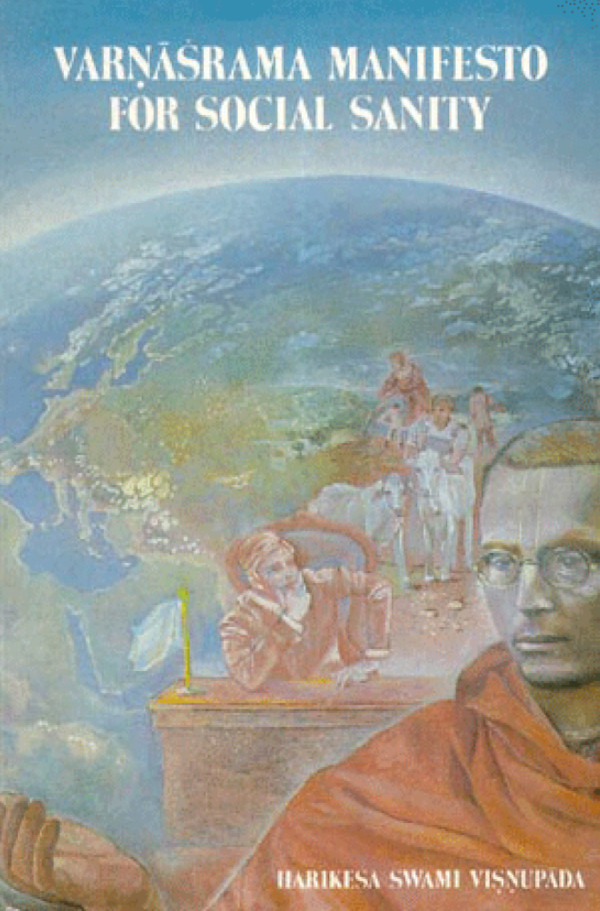
Cover of Varnashram Manifesto for Social Sanity.
Devamrita moves to New Vrindaban.
In March or April 1986, Devamrita Swami—inspired by the preaching and achievements of His Divine Grace Kirtanananda Swami Bhaktipada, the leader of the New Vrindaban Hare Krishna Community and ISKCON GBC representative for West Virginia, Ohio, Kentucky, Indiana, Western New York and Western Pennsylvania, and perhaps losing faith in his sannyasa guru Harikesh Swami—moved to New Vrindaban in Marshall County, West Virginia, the home of Prabhupada’s Palace of Gold, and a thriving community of hundreds of Krishna devotees. At this time, Devamrita Swami claimed his legal name was Jay Matsya.
Devamrita explained why he had abandoned ISKCON and joined Bhaktipada’s camp, “When I was in [Eastern] Europe [behind the Iron Curtain], I had my own scene. . . . I had charge of several countries, farms, BBT, money, hundreds of devotees falling at your feet and all this kind of stuff. But still, I could see that even though I was going all right on my own—in fact, the shadow world of ISKCON, they were going to coronate me so many titles—but by Krishna’s grace I could see that if I simply assisted Bhaktipada, that would be the best service I could do.”
Devamrita Swami wrote a homage which was published in Bhaktipada’s 1986 Vyasa Puja book. Devamrita’s homage appeared right behind Bhaktitirtha Swami and Radhanath Swami’s homages:
Dear Srila Bhaktipada,
I earnestly attempt to glorify you, because you are cent percent dedicated to maintaining and expanding the original Hare Krishna movement.
The old-time ISKCON religion, as propounded by Srila Prabhupada, pulsated with simple living, philosophical receptivity, and unbridled opportunity for enthusiasm. But now, as your younger godbrothers are entering middle age, complacency and lethargy have set in and many of us are already content to pass our remaining days in small plans and a comfortable post.
Yet, amidst the slumber and waywardness, you dare to gallantly crack the Bhakti whip of jnana and vairagya—understanding of bhagavat philosophy and renunciation of material attachments.
The sweet sound of this timeless whip fills our hearts with boundless joy, as we see the spiritual world gradually coming near.
Happily do we dip into the fountain of your Vaikuntha love and mercy and therefore always remain spiritually fresh and youthful.
A valueless servant,
Devamrita Swami
Dev Swa (as some of us nicknamed him) was a staunch sannyasi and a model member of the “New Vrindaban Woman Haters Club.” He was noted for his fired-up preaching. During a darshan early in 1986, he famously claimed, “Women are like toilets.”
During a lecture in July 1986, he explained, “Materialists, they like the smell of the opposite sex (laughs). You’ve noticed when cats and dogs are on the street, one of the main ways they tell who is a male and who is a female is by smelling. Materialist human beings today, they are always longing for the smell. . . . It sounds gross, and it is. That is modern society. For a devotee, these things are very gross, and are very disgusting.”
On October 3, 1986, Devamrita Swami delivered a lecture at New Vrindaban titled, “The Forest of Secretions and Emotions,” to warn brahmacharis about the illusions of household life. When New Vrindaban residents asked Devamrita Swami if he had ever been married, he responded, “No.”
During that same month, October 1986, Kirtanananda Swami Bhaktipada declared that Saturdays henceforward will be “Women’s Day” in the temple. The women will lead kirtan, give Bhagavatam class and dress the deities. Bhaktipada explained, “These new changes will attract some women to come to New Vrindaban. They will see that we are not male chauvinists.”
What was Devamrita Swami’s response? In an article published in New Vrindaban News, he asked, “Where will all the real men be, during the Saturday inundation? Except for the most henpecked husbands, all the men will journey to [Old] Vrindaban [Farm] to have a morning program with Srila Bhaktipada.”
Devamrita Swami continued his graphic style of preaching for decades. A devotee in New Zealand, Jatayu das (Thomas Shepherd), remembered:
I was present when Devamrita Swami gave a lecture in Auckland during the first half of 2006. It was a class exclusively for brahmacharis (no women allowed) given at a grihastha’s home where Devamrita Swami had been staying while visiting Auckland. Before he began, he told us not to record the lecture, and called out first to make sure the mataji of the house was not around. But word still got around about his famous “Huff, Puff and a Squirt” lecture. I was a guest at the time, only a teenage kid, so I had never heard anything like that before. I had expected that monks would avoid that sort of graphic talk. “By contemplating the objects of the senses, one develops attachment for them,” so the verse goes.
A week or so after the lecture, when I was washing the dishes while volunteering at Devamrita Swami’s Auckland outreach centre, called “The Loft,” one mataji in the kitchen asked me how I was enjoying visiting with the brahmacharis. I told her about the lecture and said that I wasn’t allowed to tell her what it was about, but that I thought it was really strange. She laughed and said, “Don’t worry, we ladies all know exactly what those guys talk about!”
Devamrita Swami’s “Huff, Puff and a Squirt” lecture became famous throughout New Zealand during the next few months. When I moved to live in the men’s training ashram a few months later in Wellington, they were all talking about it. Five years later in 2011, Devamrita Swami offered to give me diksa, but I politely declined.
Eventually I distanced myself from Devamrita Swami’s community and went on to discover the history of the movement before aligning myself with the ritvik persuasion. Since then, I have been active in collaborating with various groups and initiatives outside of the mainstream.
Devamrita Swami participates in the cover up of the murder of Sulochan.
When Devamrita Swami came to live at New Vrindaban, Bhaktipada gave him special mercy, and allowed him to travel with him (along with two teenage former gurukula boys) to The Netherlands and Germany in May 1986. This was when Sulochan (Steven Bryant) was murdered by Bhaktipada’s disciple Tirtha (Thomas Drescher) in Los Angeles on May 22nd. Devamrita, although most likely not involved in the conspiracy to murder Sulochan, participated in the cover up by helping impede the police investigation by admonishing Brijabasis not to talk to the media or police. Devamrita also signed a suspicious loan agreement between New Vrindaban and ISKCON Cleveland which was intended to explain why Bhaktipada’s fingerprints were found on the currency given to Tirtha for escape money.

Sulochan’s lifeless body at the Los Angeles morgue (May 22, 1986).
Scarcely a week after Sulochan’s murder, Devamrita Swami wrote a feature article for the New Vrindaban News titled “A Word To The Wise Is Sufficient” which warned devotees to keep their mouths shut if questioned by the media or police. If anyone knew of any criminal activities, he said, they should report it not to the police nor to the media, but to the temple authorities, who would, it was implied, take whatever action they deemed appropriate. Devamrita Swami preached:
Life in the material world is constantly full of upheavals, and a fruitive worker never ceases his efforts to squeeze out some sense gratification, regardless of whether the situation is one of so-called happiness or so-called distress. Right now the media and some law enforcement officials are amusing themselves by harassing the New Vrindaban Community about the death of one great vaisnava-aparadhi (offender) on the west coast.
The media and some police are clearly more interested in creating a sensationalistic atmosphere and profiting from it than in reporting truth or stopping violence. Therefore, if our devotees engage in wild rumors and gossip about the mundane affairs of L. A. street crime, they can actually help the karmis toward their sublime goal of an endless stream of “juicy” news to report and “suspicious” hearsay to interrogate innocent devotees about.
Naturally, if anyone ever has any factual knowledge of someone performing criminal acts, he should inform the temple authorities. Otherwise what is the use of exchanging who-dunit speculations about the illusory activities of the gross materialists? This is called gramya-katha, “town talk,” by Sri Jagadananda Pandit [the eternal associate of Sri Chaitanya Mahaprabhu and incarnation of Satyabhauma, who, according to Caitanya-caritamrita, prominently assisted in Mahaprabhu’s pastimes at Navadvipa and Puri], who warns devotees against indulging in such stale topics.
This is not the first time controversy has been stirred up against the community nor will it be the last. Whenever there is powerful preaching, Maya always supplies resistance. Obviously, the best thing we can do both for ourselves and all other living entities is to absorb the consciousness in talks of devotional service, specifically how to sacrifice everything to build Srila Bhaktipada’s project.
Regarding the suspicious loan agreement which Devamrita Swami signed: When Kent, Ohio police officers arrested Tirtha, they confiscated from him $4,261 in small bills. Subsequent investigation determined that Bhaktipada’s (and Radhanath Swami’s) fingerprints were on the bills. This was the money given to Tirtha to purchase airline tickets to India for himself and his family and escape arrest from United States law enforcement. In an effort to protect himself, Bhaktipada claimed that the money was given to Tirtha, not to escape to India, but as a loan for a vehicle purchase for the Cleveland, Ohio ISKCON temple. New Vrindaban’s in-house attorney, Mrgendra dasa (Harvey Mechanic), drafted a $3,000 loan agreement between New Vrindaban and ISKCON Cleveland dated May 22, 1986 (exhibit 84)—in an attempt to prove Bhaktipada’s claim that the $4,000 in small bills which were confiscated by Kent, Ohio police after his arrest were not for Tirtha, but for the Cleveland temple.
However, at the March 1991 trial in Martinsburg, West Virginia, one of the prosecuting attorneys, Michael Stein, revealed the document to be suspect when he questioned Mrgendra, a New Vrindaban resident (c. May 1986 to January 1987) who provided legal counsel for the community. Mrgendra had drafted the loan agreement between New Vrindaban and Cleveland ISKCON, which was signed by Devamrita Swami (Jay Matsya) and Tapahpunja Swami (Terry Sheldon).
Under questioning, Mrgendra admitted that the loan agreement had been pre-dated. “It [the loan agreement] was prepared approximately two weeks after that time [May 22nd],” Mrgendra explained. “Mr. [Kirtanananda] Swami . . . asked me to date it the 22nd of May, a time when Mr. Sheldon was there at the community in New Vrindaban. And so it was back-dated to that time at Mr. Swami’s request. Because . . . he heard that there was some money that was found on Mr. Drescher [when he was arrested on May 27th], and he was concerned that he cover for how the money was obtained by Mr. Drescher.”
Bhaktipada was convicted of racketeering on March 29 (Good Friday), 1991. Devamrita Swami spoke to a television news reporter and defended his master, “Bhaktipada had this dream [to build the ‘City of God’] and we’re pushing it on. We weren’t so much concerned as to whether he was sentenced to one year or a life in prison. The whole thing [criminal charges] is basically a farce, and we’re quite confident it [his conviction] will be thrown out in appellate court.”
Devamrita Swami leaves ISKCON.
In March 1987, when Bhaktipada was expelled from ISKCON, Devamrita became a staunch defender of “His Divine Grace,” and during formal lectures in the temple explained that ISKCON had, more or less, fallen away from the pure path of Bhakti Yoga. He believed ISKCON had been infected by a disease: the plague of impersonalism. Although New Vrindaban devotees were able to ward off infection by this disease, he claimed, they had nevertheless become slightly influenced.
During a May 1987 lecture, he explained: “Just like here at New Vrindaban, we’re seeing an increase in community spirit. . . . Even though the devotees [here] weren’t effected in the core of their hearts by the diseases sweeping ISKCON, but because it was in the air, there was some peripheral contamination. Unconscious. Shall we say, devotees got a little spaced out and started becoming a little impersonal. That’s the modern fad now [in ISKCON]: impersonalism. Everybody for himself, you know. You don’t need a guru. The only good guru is a departed guru. Jai Prabhupada.”
During the question and answer period following a Srimad-bhagavatam class at New Vrindaban on September 9, 1989, Devamrita Swami and Bhaktipada spoke about the envy of ISKCON godbrothers and “showbottle” religion. “ISKCON,” Bhaktipada claimed, was “dead,” “fake,” “like the display bodies [mannequins]. . . in stores.”
Adi Purusha Swami [Alfred Tarantino, formerly Ajeya dasa]: How does that envy of the advanced devotee manifest, and what is the cure for it?
Devamrita Swami: There are many ways it manifests, but the worst way is to stop his preaching. Just like Prabhupada, in that same purport [SB 7.14.24], he says, “It has actually been seen that even an authorized devotee who is engaged in the service of the Lord is criticized by neophyte devotees.” That is the worst way it manifests. If one has a contamination it would be nice if one would keep it to himself, but the way this world works is as soon as an authorized devotee propounds the science of pure devotion, immediately there is a reaction from Maya and generally the neophytes join in the reactionary side of Maya, because due to their rebelliousness they don’t want to hear this. They want to be satisfied with ritualistic religion. They like to be satisfied with so-called direct worship of the deity, because then they don’t have to surrender.
[Devamrita Swami continues:] We were recently in Chicago and Bhaktipada desired that we visit the temple there and I told him, “I have no desire.” He said, “I know that, but I desire that they not be in illusion.” So we went and we showed up with twenty-one devotees for mangal aroti and they started out with eight and got up to about fifteen. We could see that everyone was feeling very comfortable in a pressure-free environment. There was no sauce being dished out, there was no urging to do things you didn’t want to do. Everyone had their little mode of activity and was feeling some sort of satisfaction. So I told Bhaktipada, “It seems to me that they are having religion without surrender.” So Bhaktipada said, “Well, I’m going the opposite way. I am pushing surrender without religion.” [Devamrita Swami speaks directly to Bhaktipada:] Would you like to say something, Bhaktipada?
Srila Bhaktipada: Actually there is no other religion than surrender. Surrender is the bottom line: it’s the essence of religion. Without surrender, it may be a form of religion, it may externally have the appearance of a religion, but it is not religion. It is like the display bodies [mannequins] that you see in the stores. They look like they are real, but they’re dead. They’re just fake. Without surrender, whatever we do is fake. Faith without works is dead, and works without faith is useless. It’s not real. There must be the combination. So there must be surrender and there must be surrender to the right person. Krishna or his representative is the right person, but there must be surrender. Without surrender, there is no religion.
Devamrita Swami served as editor for Bhaktipada’s books, and even published a book of Bhaktipada maxims and quotes—excerpts from Bhaktipada’s classes and darshans between Autumn 1987 and Spring 1988 at his home—titled Bhaktipada Bullets. In 1992, Bhaktipada’s book How to Love God, based on Saint Francis de Sales’ Treatise on the Love of God, was published, and Devamrita Swami served as editor.
In the fifteen-page Foreword to How To Love God, Devamrita Swami wrote:
In 1966 Swami Prabhupada introduced knowledge of Krishna from India to America. Swami Bhaktipada . . . became his first student. Twenty-five years later, thoughtful persons throughout the world now cherish the writings of Swami Bhaktipada, because by the grace of his spiritual director, he has realized the actual needs of society and its individuals. Moreover, to furnish a model for how these needs can be fulfilled, he has established an alternative community in the Appalachian Hills that shelters people of all spiritual traditions. The motto of his Interfaith City is “plain living and high thinking.” Its goal is to demonstrate in everyday life the highest holistic aspiration—unalloyed love of God. . . .
Swami Bhaktipada . . . without constraint, unreservedly glorifies the boundless exchange of love between the genuinely revived devotee and the Supreme Beloved. In a world weary of religious wrangling, his book is a treasure chest of experiential heart-theology. . . .
How To Love God speaks to spiritual children with flourishing hearts. . . . The eighty-three chapters in this book resound with the hankering cries of the seeker and the exuberant shouts of the finder. Read and you will see that Swami Bhaktipada has indeed entered the rapturous garden of pure love. Expertly magnifying the fragrance of holy desire, he labors to protect us from premature self-satisfaction—the perennial foe of devotional growth. Without acute desire, even veteran spiritualists stiffen and collapse in the icy winds of secular humanism. . .
How To Love God envelops your heart with the most profound sincerity because Swami Bhaktipada wrote its jewels of meditation in a jail cell. Oblivious to the daily defamation by journalists and newscasters bent on destroying his good name, Bhaktipada prepared to unlock the most confidential spiritual knowledge—unconditional love of God. . . .
The grossly unjust incarceration of Bhaktipada allowed sincere spiritual seekers to clearly perceive a real hero and rush to his side. Even the guards at the prison noted his gentle happiness and deep inner calm. . . . Swami Bhaktipada was released from prison, pending appeal, in July, 1991. During his three months confinement, he began and finished this book. . . .
How To Love God reaffirms the spiritual perfection so utterly abandoned today. Though written by one who has been thrown to the lions, you’ll find in it not a trace of bitterness against society. . . . Let us cast our lot with Swami Bhaktipada. The pure religion his book elucidates will create the greatest heroes. Only bold spiritual champions can actually effect lasting beneficial change and teach us How To Love God.
When Kuladri and Dharmatma left New Vrindaban due to legal problems, Devamrita Swami took over their roles as Temple President and Sankirtan Leader. During this time, Devamrita gave the author a nickname: “Ye Old Prince of the Pick,” due to my past reputation as a Sankirtan Maharathi (Great Warrior).
Many New Vrindaban sankirtan pickers adored Devamrita Swami and affectionately called him “The General.” They compared him to a military leader who strategically plans and heroically leads great battle campaigns to rescue Laksmi from the conditioned souls. On the other hand, the New Vrindaban householders were not fond of him and called him “The Great Manipulator.” Bhaktipada later claimed that Devamrita Swami was “a liar.”
In May 1987, one of Bhaktipada’s fulltime traveling sankirtan devotees, my godbrother Siksastaka dasa (Scott Manley), published a book titled Devamrita Daggers, with transcripts of Devamrita Swami’s lectures and darshans.
The next year, in 1988, one of New Vrindaban’s big pickers, my godsister Compassionate Maharaja (Rosalyn Fejes, formerly Rasayatra devi dasi), compiled Devamrita Swami’s lectures into a book: Cutting The Knot of Material Existence: Lectures and Essays by His Holiness Devamrita Swami. On the book cover appeared a color photograph of a smiling Devamrita Swami sitting cross-legged and wearing his Far Eastern Buddhist robes and South-Eastern Asian conical bamboo hat.
During this time, Devamrita Swami allegedly had an affair with one of Bhaktipada’s female swamis: Steady Maharaja (Sharon Ilski, formerly Salagram devi dasi). One of my godbrothers remembered, “Devamrita (Swami) was in love with her and even took her home to meet his mother. She ended up hating him.”

Devamrita Swami in his Far East costume, from the cover of Cutting The Knot of Material Existence: Lectures and Essays by His Holiness Devamrita Swami (1988).
The Interfaith Era at New Vrindaban.
Devamrita supported Bhaktipada in his mission to de-Indianize Krishna consciousness, and Devamrita Krishna-ized several hymns by changing the lyrics to fit the Gaudiya-Vaishnava perspective. One Christian hymn which the Krishna Chorale recorded on their cassette tape Blessed Assurance, was Devamrita Swami’s adaptation of Holy, Holy, Holy, the hymn tune known as NICAEA.
(1) Hari, Hari, Hari! Lord God Almighty!
Early in the morning our song shall rise to thee.
Hari, Hari, Hari! Transcendental glory!
Infinite person, blessed purity!
(2) Rama, Rama, Rama! Perfect royal father!
When will every state and nation be like thy Ayodhya?
Rama, Rama, Rama! Savior of Sita;
Perfect in power, in chivalry and valor!
(3) Krishna, Krishna, Krishna! Reservoir of pleasure!
Hearing thy Vrindaban pastimes is the secret nectar.
Krishna, Krishna, Krishna! Conquered by Radha,
Darling of Vraja, infallible lover!
(4) Hari, Hari, Hari! All the saints adore thee!
Pious souls cling to thy feet and chant eternally;
Hari, Hari, Hari! Though illusion hides thee,
Thou wert and art and evermore shall be.
Devamrita Swami, following in Bhaktipada’s footsteps, began listening to Western classical music. He acquired a large collection of cassette tapes of music by Bach, Handel, Beethoven and other composers. In the late 1980s, Devamrita began acquiring a collection of classical music recordings on compact discs, and he gifted his cassette collection to me.
Devamrita also Krishna-ized an aria from Handel's Messiah: “I Know That My Redeemer Liveth,” and titled it, “My Spiritual Master Liveth.” This was sung and recorded by New Vrindaban’s star soprano: Ragamathani devi dasi (Rebecca Smith Fawley).
I know that my spiritual master liveth, and that by his grace even a wretch as I can love Krishna. I know that my Prabhupada liveth, and by disciplic link his will marches on! Jai Bhaktipada! And though Maya attacks this body, yet in my soul shall I be strong. Who dares measure what the guru giveth? And though fools doth protest his glory, yet through him shall I see God. For by his sweet pleasure upon the jiva, a lost servant can go back home.
Devamrita also Krishna-ized another popular Christian hymn, “Blessed Assurance,” and called it: “Blessed Assurance, Krishna Is Mine.” He also edited and published a bi-monthly (sometimes weekly) newsletter, Vrindaban Moon, from February 1988 until July 1989. The two-page newsletter featured darshans with Kirtanananda Swami Bhaktipada (“Bhaktipada Brain Food,” “Take the Leap of Faith!”), news about recent New Vrindaban developments (“Swamis to Initiate on Behalf of Bhaktipada,” “Advent of The Rule,” “Saints Ready for Xmas Delight,” “Bhaktipada Overseas”), articles about the misery of mainstream society (“Living in the USA,” “D. C. Data,” “School System Out to Lunch”) and articles about the woes of ISKCON (“Brainless Vanity”).
In the late 1980s and early 1990s, New Vrindaban pickers began collecting in the Far East, in Malaysia, Singapore and other Pacific Rim nations, because of court cases against New Vrindaban sankirtan which severely curtailed New Vrindaban’s collections in the United States. Devamrita spent much of his time in the Far East enlivening the pickers there.
Devamrita Swami praised Bhaktipada’s vision of interfaith preaching and derided the ISKCON traditionalists who claimed that Bhaktivedanta Swami Prabhupada’s vision of a Society of strict Vaishnavas was superior. Devamrita Swami explained in his book (c. early 1990s), On My Mind:
The concept of the League of Devotees or Interfaith League, as derived by Swami Bhaktipada from the original League idea of Swami Prabhupada, has shown itself to be a brilliant device for attracting people of all types to associate with devotees. Those of us who have fully tried the interfaith approach have been astounded at the untapped potential. In the post-Waco age to be a closed off exclusivist “cult” is not the zesty preaching technique that brought us so much success in the good old hippy days of yore. Back then Western culture was full of exotic splinter groups of all types—you weren’t really “with it” unless you belonged to one.
Now things are different: there’s no pressure to try and join the “right anti-establishment group” as during the counter-cultural boom years. Now everything is “individual,” everything is “your personal affair.” Today, immersing oneself head over heels in a social or spiritual movement is as weird as it was then for a young person to be a political or cultural conservative. Today, to be part of a movement is as deviant as it was then to “not be involved.”
There is a need for a Western Chaitanya Order in which we can attempt to cultivate Mahaprabhu’s dharma in Western lands, rather than hauling over from India huge shiploads of Bengali topsoil. “But,” skeptics challenge, “How many devotees does the innovative approach make!” To which I would reply, “How many devotees does the traditional approach KEEP?”
For example, out of thousands of disciples Prabhupada initiated, how many are still active in temples today? At most 200 live in a way we would not label as fringie during Prabhupada’s physical presence. The extraordinary rate of attrition means that after all the ki-jaying is done, into the closet go the dhotis and saris and soon so-and-so Prabhu is working a nine-to-five job, making mortgage payments, and watching TV in the evening.

Two important men at New Vrindaban: Community spokesman and Director of Palace Publishing Paramahansa Krishna Swami (Phillip Julius Jones) and Temple President/Sankirtan Leader Devamrita Swami sit on the wrought-iron railing in front of the RVC temple and discuss important matters (c. early 1990s).
The Winnebago Incident.
In September 1993, Devamrita was present at New Vrindaban on Bhaktipada’s appearance day (September 6th) when one of Bhaktipada’s disciples (his chauffeur Sarvabhauma dasa/Steven Travers) said he had, during the previous night during a drive from Chicago to New Vrindaban, observed his spiritual master engaging in inappropriate sexual behavior with another disciple, a 17-year-old dark-skinned young man from Malaysia. After hearing the disturbing report, Devamrita Swami approached Bhaktipada and asked him what happened.
Devamrita Swami, trying to avoid committing offenses toward his superior, cautiously approached Bhaktipada in private on the morning of September 6th at his Winnebago van and submissively inquired about his behavior during the previous night’s journey from Chicago. Bhaktipada asked Devamrita to go get Radhanath Swami.
Why did Bhaktipada insist that Radhanath Swami be present before he spoke about his inappropriate behavior with Devamrita Swami? Bhaktipada claimed that he loved Radhanath Swami. I never heard him say anything against him. However, he later claimed that Devamrita Swami was “a liar.” Devamrita Swami walked to the nearby temple, knocked on Radhanath Swami’s door and said, “Bhaktipada wants to see you immediately.”
When Radhanath and Devamrita Swamis entered Bhaktipada’s Winnebago van, Bhaktipada confessed, “I feel like Arjuna felt when Krishna left him; defeated by a couple of cowherd boys.” Bhaktipada was crying tears of shame and regret. He said he had become spiritually weakened. He asked that initiations be canceled; he said he wanted to leave the community and let the New Vrindaban devotees take care of the management as well as spiritual guidance. However Bhaktipada did not describe in detail exactly what was his sin; Devamrita claimed that he spoke in vague words with a tone of veiled mysticism.
Devamrita Swami had recently spent much time overseas, giving guidance and inspiration to Bhaktipada’s sankirtan collectors in the Far East. He told me, during the entire year of 1993 he only spent twenty-one days in New Vrindaban. He claimed he was completely unaware that Bhaktipada already had a long history of alleged inappropriate sexual behavior and might have imagined that Bhaktipada’s “confession” might refer to sins on the subtle platform, such as thinking about sex or looking lustily on the objects of desire.
After talking with his two junior godbrothers, Devamrita and Radhanath, Bhaktipada agreed to postpone initiating new disciples for the time being, but he thought that the offerings and homages for his appearance day Vyasa Puja celebration in the temple should continue as scheduled, since dozens of his disciples had traveled to New Vrindaban from Canada, India, Malaysia, Taiwan, etc., and he did not want to disappoint them. Bhaktipada also requested that a select committee of senior leaders of the community meet with him later that day at Silent Mountain and suggest a course of action he should take for his rectification.
Bhaktipada denies his “confession” for the first time.
When Radhanath Swami left the Winnebago to halt the preparations for the fire sacrifice, Devamrita Swami briefly stayed with Bhaktipada, who, in the absence of Radhanath, immediately recanted his so-called “confession” to Devamrita Swami. He said, “I don’t know what is the big deal; I didn’t do anything wrong!”
Bhaktipada seemed to be attempting to create a situation—a diversion—which would create enmity between Radhanath and Devamrita Swamis, and distract attention away from himself. Devamrita explained, “Srila Bhaktipada always played me off against Radhanath Swami, and Ramananda [one of the Far Eastern sankirtan leaders] off against me. He always had someone to play off against anyone. In this way he was the most expert faction maker and faction manipulator I have ever seen—in ISKCON that is. He was able to split off each faction or devotee into separate realities and equip each world with its own understandings suitable for his purposes. This ability proved very difficult for the devotees to even realize it existed, what to speak of fathom. And this expertise caused long-lasting havoc in devotee relations at New Vrindaban.”
To make a long story short, the community split into two nearly-equal camps: those who believed Sarvabhauma and wanted Bhaktipada removed as leader and acharya of New Vrindaban, and those dedicated disciples who believed Sarvabhauma was lying and that there was a conspiracy against Bhaktipada.
Some disciples heard that Bhaktipada’s alleged “confession” was simply a big misunderstanding. My British godbrother Narasimha Guru (Martin Lyons) explained, “Now I’m hearing from various quarters that nothing at all happened; it’s all a big misunderstanding. Bhaktipada’s initial admission of weakness and request for help was simply a spontaneous expression of humility, and we should put all this behind us and get back to normal as quickly as possible.”
Some of Bhaktipada’s disciples raced to Silent Mountain to inquire from their guru if he was actually “wounded by Maya” and unfit to be the World Acharya for the League of Devotees. Bhaktipada smiled at their concern and decidedly assured his distraught disciples that “I have not broken any of the regulative principles; there must be a conspiracy against me.”
Bhaktipada singled out Devamrita Swami as the primary conspirator. Kurma (Kindheart/Ken McLeod), a devoted Bhaktipada disciple living in Australia, recalled, “Kirtanananda Swami himself told me, very straight forward and emphatically, to completely avoid Devamrita Swami, because the Swami had told lies about him after a confessional that was . . . regarding the Winnebago incident.”
RVC Swami noted in his diary: “Big meeting and Radhanath Swami explains Srila Bhaktipada fell and will be stepping down. A letter of resignation is to be drafted by the big guns. Srila Bhaktipada did not say he fell down, and says he was wounded, but not by falling, but that his friends doubted him.”
After hearing their guru proclaim his innocence in his cabin at Silent Mountain, his devoted disciples became bitterly angry toward the “conspirators” and Ramananda dasa, the aggressive Malaysian disciple (with alleged Mafia connections) and leader of Bhaktipada’s multi-million dollar Far-Eastern sankirtan picking empire, boldly announced, “Coffins should be procured for the blasphemers who dared to spread slanderous lies about the spiritual master, Krishna’s pure devotee.”
Bhaktipada reportedly responded, “A devotee should always have his coffin ready; be ready to die any day.” Apparently threats were uttered against Radhanath Swami, Devamrita Swami, Garga Rishi (David Waterman), the Palace manager, and Sudhanu (George Weisner), a senior Prabhupada disciple. One female Brijabasi recalled, “When Bhaktipada heard of the threat against Sudhanu and Garga Rishi, his comment was, ‘A devotee should always have his coffin ready, be ready to die any day.’”
Chaos reigned. Some devotees were confused that Bhaktipada had retracted his “confession,” some were angry at the “conspirators,” and some, after hearing Ramananda’s statement, were fearful for their lives. The next morning, when the news spread throughout New Vrindaban, the community had split into two nearly-equal camps: those who dismissed the story as malicious rumor and continued to support Bhaktipada, and those who believed the story and wanted Bhaktipada out of New Vrindaban. This was the first time in the twenty-five years since Kirtanananda Swami first established the community in 1968 that large numbers of residents doubted his leadership abilities.
In private, Devamrita Swami had attempted to convince Bhaktipada that his reign at New Vrindaban was over and that he should leave the community, whether he liked it or not, or whether his disciples liked it or not. However, he was careful not to speak in the presence of Bhaktipada’s devoted sankirtan devotees, such as Bhaktisiddhanta Swami and Ramananda, who were not going to drop their guru on the spot, no matter how damning the evidence. He thought he could help keep them from leaving Krishna consciousness out of shock if he stayed with them a little longer and weathered the storm. Devamrita Swami, an educated Yale scholar, had a natural distrust and disdain of anything vox populi: public sentiment or opinion of the masses, and decided to bide his time and come up with his own plan.
Radhanath Swami departs New Vrindaban
Back at New Vrindaban, Radhanath Swami received word that Bhaktipada had recanted his “confession” and had denounced the “conspirators.” He also heard that Ramananda announced that coffins should be procured for the blasphemers. The gentle and humble sannyasi who had served Bhaktipada faithfully for twenty-one years was deeply hurt by his siksa guru’s duplicity and remained awake for the entire night, praying to his diksa guru, His Divine Grace A. C. Bhaktivedanta Swami Prabhupada, “What should I do?” Radhanath loved Bhaktipada dearly, but he couldn’t understand why Bhaktipada had begged for help and then pushed his well-wishers away, labeling them “conspirators.”
Early in the morning Radhanath Swami believed he finally received an answer to his prayers from Prabhupada in his heart: “You must leave this place immediately.” Although he tried to depart secretly, about thirty loyal well wishers begged him to stay, to weather the storm, including Devamrita Swami, who grabbed Radhanath’s arm and announced, “Why are you leaving? You’re supposed to be in charge of New Vrindaban!” Devamrita Swami then declared to the assembly, “Radhanath is not leaving! Radhanath is not leaving.”
Radhanath gravely and quietly answered, “I am leaving,” but Devamrita Swami continued to exclaim, “Radhanath is not leaving!” Finally Radhanath firmly pushed his colleague away and attempted to enter a waiting pickup truck. When Devamrita approached Radhanath for the third time, Garga Rishi, a strong man who stood over six feet tall, blocked him, uttered an obscenity, and threatened, “If you try to stop Radhanath Swami again, I’ll beat the shit out of you.”
Garga Rishi continued, “I’m normally a quiet and laid-back guy, but I could see that Devamrita was trying to keep Radhanath from leaving, against his will. Radhanath was getting upset. There was such a painful look in his eyes, and he appeared totally stressed. I just had to help him. It was a very volatile time; tensions were extremely high.”
RVC Swami noted in his diary, “Radhanath leaves and says he’s never returning to New Vrindaban or any of Srila Bhaktipada’s missions, including India. Devamrita [Swami] is in the dog house for scheming—removed as head of Far East Mission.”
Devamrita Swami departs New Vrindaban
After Radhanath Swami left New Vrindaban, Devamrita Swami also did not stay for long. Although RVC Swami claimed Devamrita Swami was removed from his post as head of Bhaktipada’s Far East collecting parties, Devamrita returned to Malaysia where he continued to supervise and inspire Bhaktipada’s multi-million-dollar Far-East picking troops. Where was the money going now? Was Devamrita Swami still sending the money to New Vrindaban, or was he quietly transferring it into another account; a secret account for his own future purposes?
One thing is certain: Devamrita Swami kept the Far-East devotees in the dark, as much as possible, regarding the Winnebago Incident and Bhaktipada’s alleged illicit sexual activities. He obviously did not want the money collections to decrease on account of disciples losing faith in their spiritual master. One Far-East picker, Adi Purusha Swami, remembered:
I was serving in Malaysia [in September 1993] and Devamrita Swami came there from New Vrindaban and said some vague things about, “Something weird’s happening at New Vrindaban.” He wasn’t very clear about it.
I’d been overseas for a year. (Imagine being on traveling sankirtan for one year.) We used to go away for four to six weeks [back in the States] and it was a long marathon. Right? So fifty-two weeks is like a kalpa [year of Brahma] in comparison.
I think you have no idea how interesting that was for me [to hear that something weird was happening in New Vrindaban]. I felt like I was in the dark. So I sat down and wrote twenty-four letters inquiring: “What is going on?” I wrote to RVC Swami, Murti Swami, Sudhanu, you, Eternal Love, Compassionate and two dozens of devotees.
But only Compassionate and Eternal Love wrote back and they were also brief and not totally clear. [It is not hard to imagine that Devamrita Swami must have censored Adi Purusha’s incoming mail, as I am sure I mailed him a copy of my 15-page letter.] Then Bhaktipada sent me to New Zealand for a year, then called me to New York City.
In a February 8, 2003 email to the author, Devamrita Swami wrote, “Those days were full of abnormal extreme stress. . . . those wild, complicated and tangled times. A Kirtanananda Swami on track was one of ISKCON’s greatest visionaries. But that brilliance also manifested as ingenuity at spinning off each individual into a separate universe, replete with its own stories and plot, and then manipulating them. In other words, a very sophisticated way of divide and conquer. Thus you’ll hear so many different angles and visions, depending on who you talk to and what was the reality in their universe. Few have figured this ploy out, to this day.”
Devamrita Swami returns to ISKCON.
Devamrita Swami eventually returned to ISKCON. ISKCON was extremely lenient on him. They basically ignored his transgressions and preaching against ISKCON during his seven years as an officer in Bhaktipada’s “Eternal Order of the League of Devotees Worldwide,” and granted him amnesty: an official pardon for any wrongdoing or illegal activities he might have committed. In 2001 Devamrita was appointed a candidate for the GBC for Ecuador, Peru, Chile and Bolivia. In 2002 Devamrita Swami was appointed as an assistant GBC member and an official ISKCON guru, in 2003 he was elected as an acting GBC member, and in 2004 he was elected a full GBC member. In 2005 he was elected to the post of GBC chairman.
August 2023 advertisement for Devamrita Swami’s lecture in Los Angeles.
Since returning to ISKCON, Devamrita Swami has authored three books:
(1) Perfect Escape (1996),
(2) Searching for Vedic India (2002), and
(3) Hiding in Unnatural Happiness (2015).
Three other books by Devamrita Swami, or about him, were published at New Vrindaban:
(1) Devamrita Daggers, lectures and darshans by Devamrita Swami, Siksastaka dasa (Scott Manley), editor (1987)
(3) Cutting The Knot of Material Existence: Lectures and Essays by His Holiness Devamrita Swami, Compassionate Swami (Rosalyn Fejes), editor (c. 1988)
(3) On My Mind, ruminations by Devamrita Swami (c. early 1990s).
These last books can be found at the Swami Bhaktipada Archive at the West Virginia Regional and History Center at West Virginia University in Morgantown, West Virginia.
Controversy
Devamrita Swami has been involved in some controversy. One Australian devotee recalled, “Devamrita Swami: the co-GBC of Australia. I heard that a young brahmacharini in Adelaide temple had suffered serious sexual assaults by the son of the Temple President. Friends were encouraging her to go to the police. What does our illustrious guru and top manager do? He sends a voice message to the victim recommending she lie to the police and say any sexual activity was consensual and she needed to be married. Bravo Maharaja. Way to go in protecting women from predators.”
In the following email dated June 12, 2018, Devamrita Swami addresses a few concerns regarding his past:
FROM: Devamrita Swami (devamrta.swami@gmail.com)
Date: Tue, Jun 12, 2018 at 11:00 PM
Subject: Declaration
To: Dear Esteemed Maharajas, Temple Presidents, and Devotees,
In February of this year at the annual GBC meetings I met with a cohort of my GBC god brothers at their request to address some concerns raised in regards to the transparency of my past when it comes to accepting and initiating disciples. The conversation was conducted respectfully and in a collegiate manner and I have humbly conceded to comply with some conditions put forward during the discussion. Those conditions are...
That the following declaration be made available to all current disciples and existing prospective disciples That appropriate temple authorities discuss the below declarations with any future prospective disciples before such candidates approach me for shelter and immediately upon learning that the candidate is seeking shelter from me.
That the below declarations be made publicly available in all temples and zones where I am a GBC, hold a position of leadership, or have a significant number of supporters My declaration... The proverbial 'elephant in the room'... my re-entry in to Iskcon after being excommunicated during the New Vrindavan years was under an agreement of amnesty, I continue an expectation of that amnesty being honored.
I reserve my right to silence on questions around my involvement in the activities of the time, assets I had control over, and the ongoing proprietorship of said assets.
In unison with the vast majority of my sannyasi godbrothers I decline to participate in the GBC mandate that sannyasis declare their assets and income on an annual basis.
I include questions around my Australian registered company ‘Jay Matsya Superannuation’ within this privacy. I have several aliases that I have not deemed necessary to declare publicly in the past, Devamrita Swami, Jay Matsya, and my birth name Lee Reynolds.
I have been married and divorced twice, once to a Polish devotee, once to a Danish devotee. There have been times where I have denied being married. In 2016 a recording was made public of me giving advice in regards to how local authorities should deal with the reporting of a sexual assault. In the recording I advise them to try and get the victim to state it was mutual and that it will all go away. No Iskcon authority has expressed to me that this advice is inappropriate.
Your humble servant,
Devamrita Swami
Currently Devamrita Swami is based in Australia and New Zealand, and frequently travels to India and the Orient. For more about Devamrita Swami, go to: DevamritaSwami.Com.
Author’s postscript.
I knew Devamrita Swami when he served at New Vrindaban from March or April 1986 until he left New Vrindaban shortly after the September 6, 1993 Winnebago Incident. I tried to keep my distance from him; we were never close, although more than once he offered me unsolicited counsel regarding my unhappy marriage with an Indian godsister. (For more about Devamrita Swami’s marital advice to me, see Passion On The Edge: Love and Marriage Amongst the Hare Krishnas—A Case Study).
When Devamrita Swami became New Vrindaban’s sankirtan leader, my days as a big picker were already over. I only went out on weekends. Perhaps that is why he dubbed me “Ye Old Prince of the Pick.” (He called my godbrother Bhaktisiddhanta Swami “The Emperor of the Pick.”) Once I rode with Devamrita in the backseat of a small car during a night drive from New Vrindaban to Cincinnati, Ohio, probably for a big pick. My godbrother, Siksastaka dasa (Scott Manley) drove the car, and Devamrita Swami sat in the passenger seat. He was playing cassette tapes of jazz musicians in the car stereo system: Thelonious Monk, John Coltrane, Charles Mingus and others.
Unfortunately (for me), he insisted that the stereo volume be set on full blast. I remember this incident because at the time I had a splitting headache, and although I enjoy listening to great jazz, the high volume made my headache worse. I suffered in silence, realizing that perhaps Devamrita insisted the volume be set high to help keep Siksastaka awake at the wheel. I never held that against him; it was just an unfortunate experience for me.
I met Devamrita Swami again during a visit to New Vrindaban, I think in 2003. We chatted amicably. When I asked him why I never heard that he apologized for serving my disgraced spiritual master for so long, in illusion thinking Bhaktipada was a pure devotee, which ultimately caused so much suffering, and why he didn’t immediately reject Bhaktipada, as I did, after the Winnebago Incident of September 1993, he became indignant, and responded, “Do I have to keep apologizing over and over again, forever?” Since then we exchanged a few emails, but mostly have been out of touch.
Devamrita Swami appears prominently in seven of my New Vrindaban history books, as he was certainly a very important member of the community:
Killing For Krishna,
Gold, Guns and God, Vol. 4,
Gold, Guns and God, Vol. 6,
Gold, Guns and God, Vol. 7,
Gold, Guns and God, Vol. 8,
Gold, Guns and God, Vol. 9, and
Gold, Guns and God, Vol. 10.
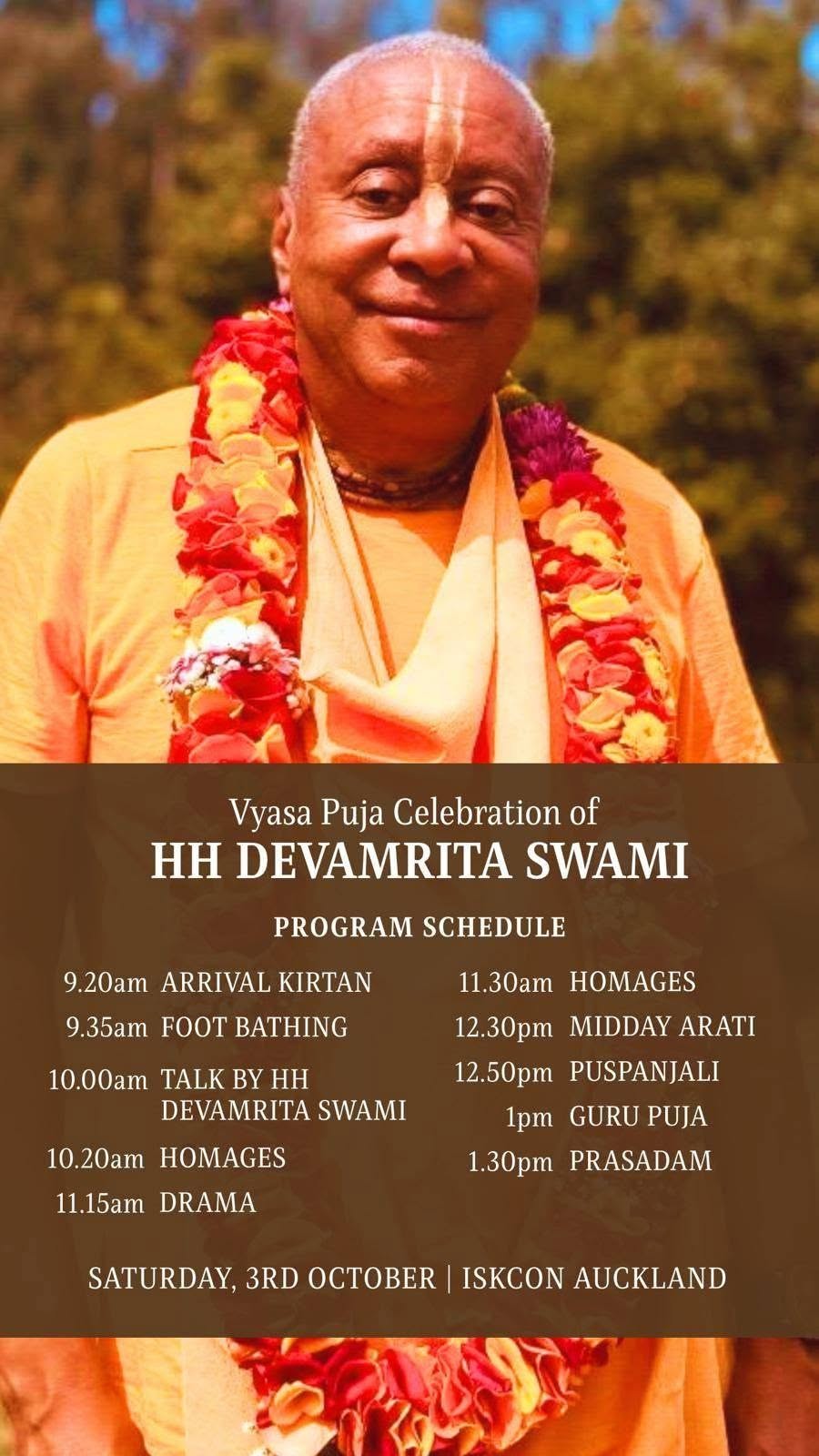
Advertisement for Devamrita Swami’s October 2026 Vyasa Puja festival at ISKCON Auckland.
Readers respond:
Great work Henry. Should he continually have to apologize over and over again? If he truely regretted what he’d done, then the regret would never leave him and the apology would live on his lips, eager for every chance he had to give it to assuage in some small part the harm that he had contributed and done to those who still suffered from them. So I’d say that his apologies were disingenuous and insincere to begin with, made from a heart where goodness and mercy do not live.
His behavior with women shows to me that all his clap trap against them is just a marketing strategy to make him appear like he’s unattached to women, when in reality he likes to have sex with them, and then lie and pretend that he can keep his hands off them. He appears to me to be psychologically abusive toward both women and kids or at least he writes and preaches in such a way so as to condone and encourage such abuses. i couldn’t be friends with such a person or even see him in the temple without being tempted to drag him outside and kick him down the steps, as I know that Krsna must hate him. What is that old saying? “As ye have done to the least of them you have done unto Me.” You can build temples as high as you like, praise Krsna with every breath, but if you mistreat kids or women it isn’t your prayers to Krsna that God is hearing, but the sound of women and children sobbing. How many times should he apologize? How many times is Krsna listening, how many times are those tormented and abused still hurting?
George Smith
Overland Park, Kansas
| Back to: Killing For Krishna Homepage |