Henry Performs at AGO Recital

At Trinity Episcopal Church, Escondido California.
Sunday March 8, 2026: Henry performed, along with eight other musicians and dozens of singers, in recital at the American Guild of Organists Palomar Chapter Annual Scholarship Fundraiser Recital at Trinity Episcopal Church in Escondido, California. Henry was accompanied by pianist and Palomar College faculty member and current Palomar Chapter Dean: Dr. Michael D. Munson.
The two musicians performed:
• Astor Piazzolla (1921-1992): Oblivion
• Arvo Pärt (b. 1935): Spiegel im Spiegel
Henry explained,
I was very happy to play Astor Piazzolla’s Oblivion and Arvo Pärt’s Spiegel im Spiegel with Dr. Michael Munson assisting on piano. I have known him close to ten years as a long-time member and current Dean of the American Guild of Organists Palomar Chapter, of which I am affiliated. The two of us had recently performed these two pieces at a recital at Palomar College only ten days earlier. Many people in the audience came up to me later and expressed amazement at the sounds my accordion produced. One lady couldn’t imagine that she was hearing an accordion. Here’s the program notes for the two pieces:
Oblivion is a 1982 composition by Argentine tango composer and bandoneon player Astor Piazzolla. It features a passionate, melancholic melody built on a slow milonga rhythm with jazz-influenced harmonies. It has been extensively arranged for various instruments and recorded by numerous classical and jazz artists.
Spiegel im Spiegel (German for mirror(s) in the mirror) is a composition by Arvo Pärt written in 1978, just before his departure from Estonia. The piece is in the tintinnabular style, in which a melodic voice (operating over diatonic scales) and a tintinnabular voice (operating within a triad on the tonic) accompany each other. Spiegel im Spiegel was written for piano and violin. The piano plays a seemingly endless series of rising triads and the solo part consists of slow F major scales that rise or fall; they increase in length during the piece, all ending on the same note: A.
Initially, the melody consists of only two notes, with another note being added with each of the following phrases, thus creating a seemingly endless continuum. After each distancing, the melody returns to the central pitch of A, which, according to the composer, is like “the returning home after being away.” The piano part accompanies the melody part at each step like a “guardian angel,” as the composer himself likes to say. In addition to the accompaniment, the piano part includes tintinnabuli notes—like little bells that alternately sound above and below the melodic line, following a fixed formula.
Arvo Pärt (born September 11, 1935) is an Estonian composer of contemporary classical music. Since the late 1970s, Pärt has worked in a minimalist style that employs tintinnabuli, a compositional techniqe he invented. Pärt’s music is in part inspired by Gregorian chant. His most performed works include Fraters (1977), Spiegel im Spiegel (1978), and Für Alina (1976). From 2011 to 2018, and again in 2022 and 2025, Pärt was the most performed living composer in the world. The Arvo Pärt Centre in Laulasmas was opened to the public in 2018.
To listen to Henry and Michael playing Oblivion, go to: YouTube.
The Concert Program
Also Sprach Zarathustra - Opening Fanfare Richard Strauss
Ode to Joy - Hymn 376 Ludwig Van Beethoven
• David Lewis
German Chorale - “Praise Waits for Thee in Zion” Arr. Lowell Mason
• Alaina Postma - Student of Michael Munson
Cantilène and Toccata from “Trois Pièces pour Orgue” Gabriel Pierne
• Ronèl Wishnuff
Joy is Everywhere - Quoting a Neapolitan Song by John Naples
• John Naples
Two German Chorales Arr. Paul Manz
Valet will ich dir geben - Rejoice, Rejoice Believers by Melchior Teschner - 1614
Auf, auf mein Herz - Awake, my Heart, with Gladness by Johann Cruger - 1648
• April Snyder
Prelude in C Minor - BWV 549 Johann Sebastian Bach
• Aleethia Sun - Student of Emma Whitten
Fantasia on “Greensleeves” Ralph Vaughan Williams
Adagio Cantabile from “Sonata #2 for Solo Violin” Johann Sebastian Bach
• David Lewis
Salix and Toccata from “Plymouth Suite” Percy Whitlock
• Michael Munson
Oblivion Astor Piazzolla
Spiegel im Spiegel - “Mirror in the Mirror” Arvo Pärt
• Henry Doktorski, accordion, with Michael Munson, piano
Finale from “Organ Symphony No. 8” Charles Marie Widor
• Amber Dahlberg
Psalm 150 - “O Praise Ye the Lord” César Franck
Alleluia from “Exsultate Jubilate” Wolfgang Amadeus Mozart
Hallelujah from “Christ on the Mount of Olives” Ludwig Van Beethoven
• The San Luis Rey Chorale
About Dr. Michael D. Munson:
Dr. Michael D. Munson earned his Doctor of Musical Arts in Piano Accompanying and Chamber Music from the Eastman School of Music in 1992. Since 1994, he has been working at Palomar College when he started accompanying ballet classes, which he still does. Currently, he teaches applied piano, plays for ballet, and accompanies the Palomar Chorale. He has taught beginning piano, music theory, and organ. He also accompanies and coaches students in the music program at MiraCosta College.
Dr. Munson is also the organist of the First United Methodist Church of Escondido, a Life Member of the American Guild of Organists (AGO) and a former Dean of the Palomar Chapter of the AGO. He has concertized in Southern California, the eastern United States, and Europe. He has also given three concerts at the Spreckels Organ Pavilion as part of the weekly Sunday Concert Series there.
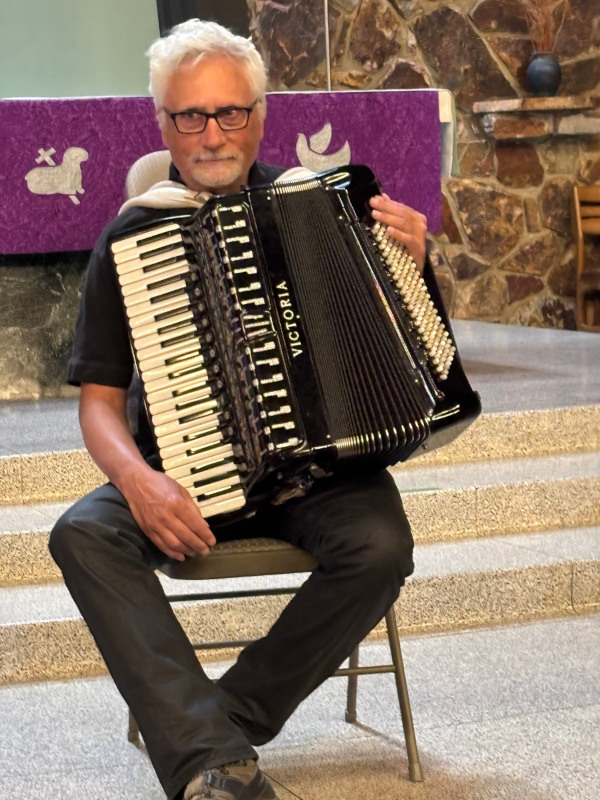
At Trinity Episcopal Church, Escondido California.
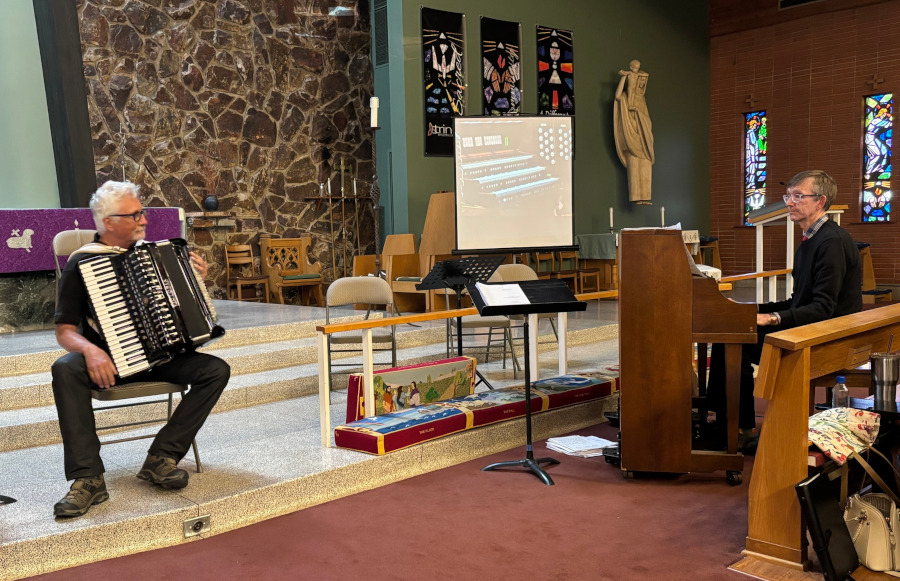
With Michael Munson at Trinity Episcopal Church, Escondido California.